The history of Russian emigration is first and foremost the history of preserving national culture, faith, and human dignity
By Ekaterina Grig
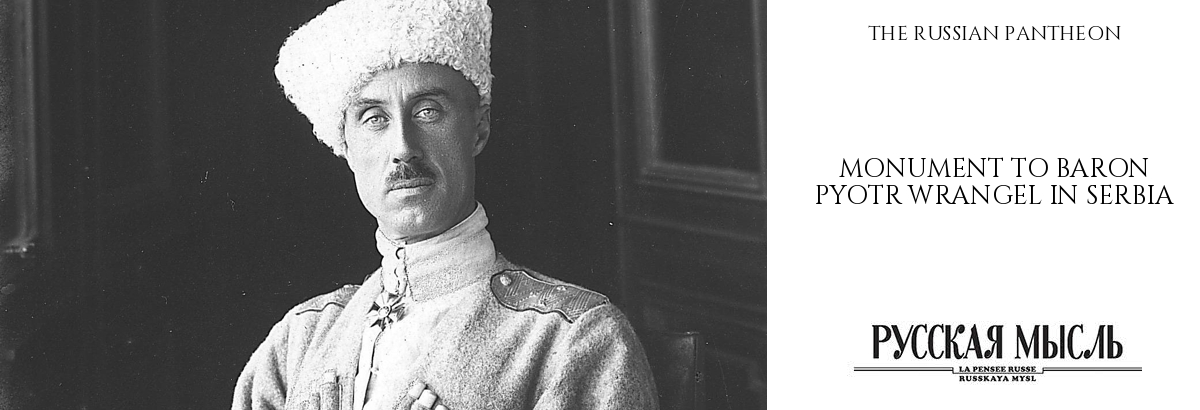
A monument to the last commander-in-chief of the Russian Army and leader of the White Movement, Baron Pyotr Nikolaevich Wrangel, was unveiled in the autumn of 2007 in Sremski Karlovci, a historic Serbian town on the Danube River.
It was a significant event not only for the descendants of Russian emigres, but also for the Serbian public: following the tragic events of the Civil War and the evacuation of the Russian Army from the Crimea in November 1920, it was the Kingdom of Serbs, Croats and Slovenes that became a true refuge for people who had lost their Fatherland and one of the main centres of Russian emigration. Tens of thousands of Russian Army officers, scientists, engineers, writers, philosophers, and members of the Russian aristocracy found shelter here. Many Russian Army institutions and emigre public organisations were then situated in Belgrade.
Wrangel was undoubtedly one of the key figures of the Russian emigration. He played a huge role in preserving the unity of the Russian Army outside of Russia. Wrangel took up his residence in Sremski Karlovci in 1922, moving there from Constantinople with his staff.
In 1924, Wrangel founded the Russian All-Military Union, which united most of the White Movement participants in emigration.
In September 1927, the baron with his family moved to Brussels, where he died suddenly on 25 April 1928. In October 1929, General Wrangel’s remains were reburied with military honours at the Russian Holy Trinity Church in Belgrade.
The history of the Russian emigration is not only that of defeat and exile. It is first and foremost the history of preserving national culture, faith, and human dignity. This is precisely the meaning that the monument to Baron Wrangel acquires in modern Serbia.
Today, Russian heritage remains an important part of Serbia’s cultural world. Russian churches, necropolises, educational institutions, and memorial sites testify to the depth of historical ties between the two nations.

Wrangel, in Sremski Karlovci. Serbia. 2077. Sculptor: Vasily Azemsha
The idea to set up a monument to Baron Pyotr Nikolaevich Wrangel was conceived in the early twenty-first century thanks to a renewed interest in the history of the Russian diaspora and the role of Serbia in the fate of Russian emigres.
Work on the project was the result of cooperation between the Serbian authorities, representatives of the Russian Orthodox Church, public organisations of the Russian emigration, and Russian foundations engaged in the preservation of historical heritage.
The main goal was to create a monument seen not as a political symbol, but as a tribute to a man who played a major role in the fate of tens of thousands of Russian refugees after the Civil War.
The monument by the sculptor Vasily Azemsha is crafted in a realistic manner: the general is depicted in a military uniform, but in a calm and restrained pose, without excessive heroisation. Behind the monument, installed in front of the city hospital where refugees from Russia were housed in the 1920s, a large memorial stand is placed featuring photographs of officers and soldiers of the Russian Army who ended up in emigration in the Kingdom of Serbs, Croats and Slovenes.
Reflecting the tragic fate of the White Movement and the flower of the Russian nation forced to leave their Fatherland, the monument to Wrangel emphasises above all his personality as a man of honour who kept his dignity in the face of historical catastrophe.
The White struggle is the honest revolt of the Russian people against the brazen violation of everything sacred to them: Faith, Motherland, and the age-old foundations of the state and family. It proves that honour is dearer than life and death is better than slavery to hundreds of thousands of Russian people. It is finding a purpose in life for those who, having lost their Motherland, family, and property, have not lost faith in Russia. It is the realisation of a sense of duty to the Motherland by tens of thousands of youths – the sons of future Russia. It is the salvation of Europe from the Red yoke and the atonement for the betrayal of Brest-Litovsk.
Pyotr Wrangel