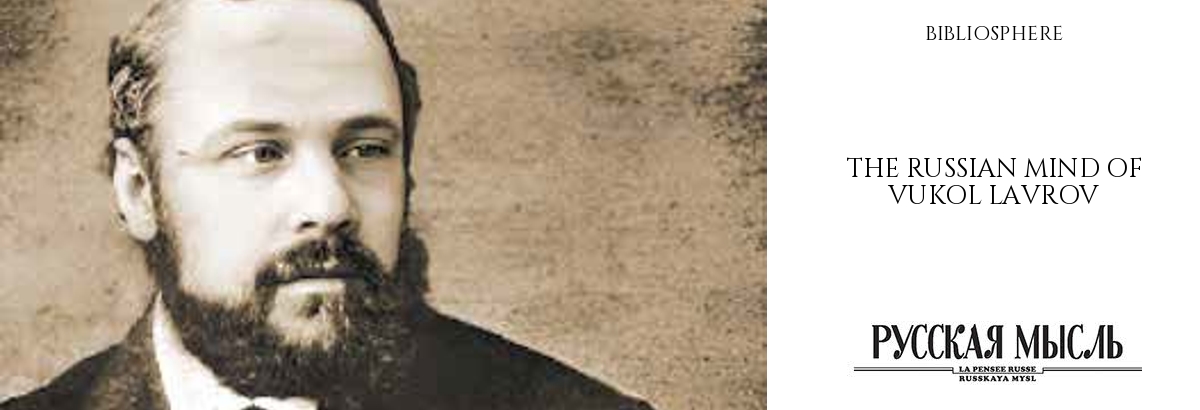
We offer our readers excerpts from the book, ‘Vukol Lavrov. The Publisher of the Russian Mind Magazine’, by Anna Mikhailovna Lavrova
Lineage
The Census Lists. Lavrov-Krechet
From childhood, I listened to my father’s stories about the Russian Mind magazine, which was published by my great‑grandfather Vukol Mikhailovich. When I got married and moved to live permanently with my husband in Moscow, I began studying old documents at the Central State Archive, the notebooks of my grandfather and father, old letters, certificates, and photographs – everything that has been preserved since the nineteenth century. I managed (thanks to earlier research into the census lists conducted by my father and his cousin Boris Vsevolodovich Doroshevsky) to trace our family tree back to the twelfth generation.
 Legend has it that an ancestor of our Lavrov family, nicknamed Krechet (“gyrfalcon”), was one of the instigators of the Streltsy Uprising [a revolt by the Moscow guard regiments in 1698]. After the uprising was suppressed, he was executed by quartering on Peter I the Great’s orders. His family was exiled to Russia’s North, later moving to the district town of Yelets, Oryol province (a railway station near the Sosna River; now in the Lipetsk region), known since 1146. It was founded as a border fortress of the Ryazan Principality to protect it against the Polovtsians. Grain, flour, and bread were exported from Yelets (mostly to Moscow). Leather and iron-foundry production were well established. The town was and still is famous for its hand-made lace. Yelets is also known as the birthplace or home of the writer I. A. Bunin, the philosopher and writer V. V. Rozanov, the painter V. N. Mashkov, the writer M. M. Prishvin, and the composer T. N. Khrennikov.
According to the census lists (name-based population censuses of Russia from the eighteenth to the first half of the nineteenth century, St Petersburg), it turns out that in 1720, Siluyan (Siluan) Lavrov-Krechet – the grandson of a strelets broken on the wheel – appeared in Yelets. Siluyan Lavrov, who settled in Yelets with practically empty hands, had a hard time. But gradually he set up a grain trade, got married, and in 1732 his son Matvei was born. Matvei, in marriage with Anisiya Mikhailovna (nee Sergeyeva), daughter of the priest of the Dormition Church in Yelets, had a son, Ivan, in 1758. Ivan, in turn, and his wife Ekaterina Alexandrovna had a son, Mikhail (1780–1852). Mikhail Ivanovich still bore the nickname Krechet, while his sons, Vukol, Mikhail (my great‑great‑grandfather), and Alexei Mikhailovich, already lost this addition to their surname, though they still used it sometimes.

I still have the abacus of my great‑great‑great‑grandfather, Mikhail Ivanovich Lavrov. It is very beautiful and well-made, with the base reinforced with copper corners (42×26 cm).
Mikhail Mikhailovich Lavrov’s Family
Sons Meliton and Vukol. The Exiled Pole Bolesław Ivanovich Zelinski and His Influence on the Young Vukol. Interest in Poland and Its National Heroes
Vukol Mikhailovich Lavrov (my great‑grandfather) was born into a wealthy, traditional merchant family in the town of Yelets, Oryol Governorate, on 11 September (according to the old calendar) 1852, the year his grandfather Mikhail Ivanovich died, and was baptised on the same day. He was named after his uncle, his father’s brother, Vukol Mikhailovich. His godparents were “the merchant Vasily Petrov and the merchant’s daughter, Nastasya Nikiforovna Rostovtseva; he was baptised by Priest Grigory Rodionov with his church staff.”
Vukol’s father, Mikhail Mikhailovich, along with his brothers Vukol and Alexei (all first-guild merchants), engaged in wholesale trade, supplying flour not only to nearby provinces but also to Saint Petersburg. According to legend, all three brothers initially lived in their father Mikhail Ivanovich’s ancestral home before moving out. Mikhail Mikhailovich bought a very beautiful white house from the sons of Kirill Petrovich Zheludkov, who had sold the house after their father’s demise.
Mikhail Mikhailovich Lavrov (1808–1877) was an extremely educated man. He subscribed to newspapers and magazines, owned a large library, and made his children read all the books in it.
Mikhail Mikhailovich created a wonderful home art gallery. In December 1852, he was elected mayor of the town, and he also served as the churchwarden of the Yelets prison castle. He was involved in charity work: in particular, he donated 3,000 silver roubles (which was a substantial sum at the time) for the repair of the Yelets prison castle. A document exists in which the “Yelets District department of the Prison Patronage Society” asks Mikhail Mikhailovich to accept the position of director of the local prison department. Ivan Bunin describes this very prison in The Life of Arseniev.

Mikhail Mikhailovich’s wife, Kapitolina Nikolaevna (née Rakova; 1808–1897), was very devout, made endless pilgrimages to holy sites and taught her daughters Larisa (b. 1837), Alexandra (?), and Yevdokia (b. 1845) to do the same. She made them pray for a long time, both morning and evening. The family had two sons: Meliton (b. 1843) and Vukol (b. 1852).
Kapitolina Nikolaevna was known for her extreme thriftiness, and she was strict and demanding with her children. The family was deeply patriarchal; all the children obeyed their father unquestioningly, and the daughters, too, obeyed their mother, who held a lot of sway over them.
The elder son, Meliton, helped his father with his trade operations. The younger, Vukol, was nine years younger, so he was looked after by his sisters, who adored their little brother, spoiled him, but also taught him geography, history, literature, music, and foreign languages. Naturally gifted, he boy quickly absorbed and remembered everything he heard. Vukol completed only three years at the town school in Yelets, as his father decided that it was time to prepare him for trade. Fortunately, the boy had received a thorough home education.
Mikhail Mikhailovich Lavrov, a man of progressive views, sympathised with the exiled Poles, welcomed them into his home, and helped them find jobs and housing. In 1863, after the Polish revolt, a Polish student from the Mathematics Department of Moscow University, Bolesław Ivanovich Zelinski, was exiled to Yelets. Vukol’s father took a warm interest in him, sheltered him in his home, and Bolesław began tutoring Vukol in mathematics and the Polish language. According to the account of Vukol’s son, Mikhail Vukolovich (my grandfather), Vukol won a gold medal at a mathematical competition held in the UK for an original solution to a problem. In addition, he learned Polish and spoke it fluently. Later on, he quickly and equally well learned Italian and French. He maintained warm, friendly relations with Bolesław Zelinski for the rest of his life. Zelinski had a son, Wáclaw, of whom it is only known that he committed suicide when he was young.
Under the influence of Bolesław Zelinski, the boy developed a keen interest in Polish history. He was particularly struck by the life of Valerian Lukasinski, who in 1830, following the Polish uprising, was imprisoned in the Shlisselburg Fortress on Orekhovy Island at the source of the Neva River. He was placed in a solitary confinement cell where he spent thirty-eight years and died there. Above his bed, Vukol hung portraits of Valerian Lukasinski and Tadeusz Kościuszko, also a fighter for Poland’s freedom and independence. Later on, those portraits hung in Vukol Mikhailovich’s study at his Maleyevka estate.
Nicholas I’s Charter
Hereditary Honorary Citizenship
As early as 1785, Empress Catherine the Great set apart a prestigious category of honorary citizens among urban residents. In 1807, the title was granted only to people of creative professions, but later it was revived for all free people. The honorary title was granted no earlier than a decade of useful activity, and after the second decade, one could already apply for a hereditary honorary title. For instance, such a title could be received by a merchant who managed to remain in the first guild for twenty consecutive years. The recipient of the title of honorary hereditary citizen was presented with a special charter.
In June 1854, Mikhail Mikhailovich Lavrov and his brothers Vukol and Alexei Mikhailovich (with their wives and children) received charters granting them the title of hereditary honorary citizenship. They had to pay a fee of 330 silver roubles to the Senate Treasury for this, which they did. Thus, Mikhail Mikhailovich Lavrov, my great‑great‑grandfather, became a hereditary honorary citizen, a title that also passed to his descendants, but in the Soviet era this had to be forgotten.
Vukol Mikhailovich Lavrov
Involvement in His Father’s Business. Marriage
When Mikhail Mikhailovich’s son, Vukol, turned thirteen, his father decided that the boy had grown enough and should now help him and his older brother with business. Young Vukol had to learn the intricacies of his father’s work, and by the age of sixteen – to travel around nearby cities; later, his travel range expanded, as he needed to find new buyers and negotiate with them. In Moscow, where he often visited, Vukol attended various literary clubs whenever he had the chance. He was simply obsessed with literature, reading voraciously not only what his father subscribed to, but also what he bought himself during his travels. Though trade did not attract him in any way, he understood that visiting various cities in Russia allowed him to learn about life and make interesting acquaintances.

When he visited Moscow, he always tried to take part in its cultural life, attended lectures on literature and mathematics at Moscow University, went to theatres, especially the Maly Theatre, and spent long hours reading at the Rumyantsev Library.
When Vukol was not yet nineteen, he had to get married. His father decided so, and there was no way to dare contradict him.
The father’s word is law. His father himself chose a wife for his son from the wealthy Khrennikov merchant family, a young lady named Varvara Nikolaevna. Vukol didn’t even have time to get to know his future spouse, let alone see her before the wedding had already been arranged. The young couple saw each other for the first time at their wedding.
Marriage wasn’t in Vukol’s plans, but avoiding it was impossible; such was his father’s will, and such were the customs in merchant families of that time.
His Father’s Death
A Million-Rouble Inheritance. Vukol’s Departure to Moscow
In 1877, Mikhail Mikhailovich Lavrov, Vukol’s father, passed away, leaving a monetary inheritance of several million to his children, of which Vukol received over a million roubles. Vukol came from Moscow for his father’s funeral, where he received his share of the inheritance, and immediately decided to devote himself solely to literature and art, and not to carry on his father’s business. His older brother Meliton took care of it.
Varvara Nikolaevna never understood her husband’s passion for literature and art. This led to endless disagreements and arguments. The young wife wanted her husband, the father of their children, to live in Yelets and continue the work that his father, grandfather, and great‑grandfather had done. By that time, Vukol and Varvara already had five children.
But Vukol yearned for Moscow. He wanted to write books and run a newspaper or a magazine. His wife complained, but he quickly closed down the old business that had been a burden to him for years. He moved to Moscow, leaving his young wife and five children with a generous income. He spared no money on music and language lessons for the children though. He never set foot in Yelets again. Varvara Nikolaevna sometimes visited Moscow with one child or another. In the end she and all the children moved to live in Moscow and St Petersburg.
Early days in Moscow
Getting settled. Reply to his wife’s letter
On arriving in Moscow, Vukol stayed at a hotel, but looked for a spacious house. First of all, he visited the Maly Theatre, where he met actors he had already known from previous trips to Moscow, made friends with many of them and carried this friendship throughout his life. It was in this company of actors that Vukol met Sergei Andreyevich Yuryev (a translator, critic, and editor), with whom he shared his cherished dream of buying and launching a literary magazine. Later Vukol spared neither funds nor effort for this. Yuryev promised his support and help, and he kept his word.
Varvara Nikolaevna wrote letters from Yelets to her husband Vukol Mikhailovich in Moscow. She begged him to return to his hometown, but he ignored her requests. In response, Vukol ikhailovich invited her to come to Moscow with Anyuta or Pyotr and take a closer look at life in the city, thinking that she might like it and their family would reunite. However, Varvara Nikolaevna was disinclined to go to Moscow, as she couldn’t leave the other younger children unattended. She wanted the father of five children to return to his native town. She complained about her husband to her family and friends, asking them to convince him, but none dared to do so. Varvara wrote accusatory letters to Vukol.
However, it was clear from Vukol Mikhailovich’s letters that he would never return to Yelets, but he would not abandon his family, would always financially support his children whom he loved, as well as his wife. But he was unhappy that his spouse involved relatives and acquaintances in their family dispute; this irritated him, and in response to the accusations he wrote angry letters to Yelets.
Varvara Nikolaevna did not go to Moscow. Their eldest son, Pyotr, immediately took his mother’s side and never saw his father again, coming only to his funeral. He did, however, write him a letter explaining why he had been expelled from the University following student unrest.
When the children grew up, Varvara Nikolaevna moved to Moscow, where Vukol Mikhailovich rented a house for them. Neither Varvara Nikolaevna nor the children wanted for anything: Vukol Mikhailovich paid for absolutely everything.
As their daughters, Lydia and Anastasia, grew older, they visited their father very often and later stayed for long periods at his Maleyevka estate, especially during the summer.
To be continued