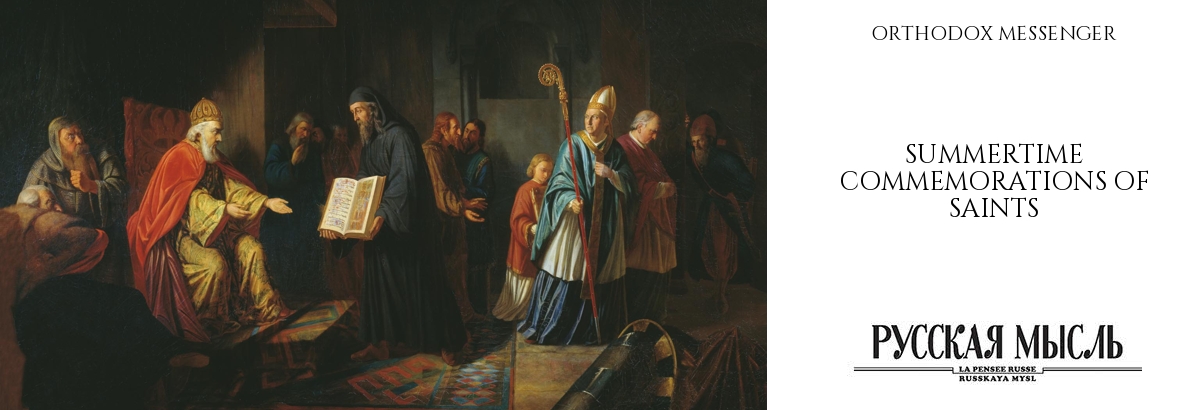
In the months of July and August, the Orthodox Church enters into the remembrance of three remarkable saints
By Augustin Sokolovski, Doctor of Theology, Priest
In one of his works, the Russian writer Andrei Platonov (1899–1951) describes the moment when the soul suddenly realizes that summer is coming to an end. Yet instead of sadness, the heart is unexpectedly filled with joy and the desire to continue living, for another summer will surely come. In July and August, the Orthodox Church celebrates the memory of three remarkable saints. The first of them, according to the liturgical calendar, is Saint Metropolitan Photius.
Saint Metropolitan Photius
On July 15, the Church commemorates Saint Photius, Metropolitan of Kiev (+1431). According to the Old-Style calendar, his feast falls exactly in the middle of summer, making it easy to remember. Photius was later glorified as a saint. Shortly afterward, the Russian Church began to elect its own metropolitans, and his two immediate successors were not entirely successful. Thus, Photius became the last saintly Metropolitan sent from Constantinople to Rus’.
Although he was Greek and, at least at the beginning of his ministry, did not even know the Russian language, his glorification as a saint came gradually over the course of centuries. As was often the case with Russian saints, his canonization was not accompanied by the triumphant public acclaim that frequently surrounded such events.
His ministry proved to be remarkably long, lasting more than two decades. The future capital of the Russian state had been devastated by Edigu, ruler of the Golden Horde, in 1408, almost simultaneously with Photius’ election to the metropolitan see. Only two years later, in 1410, did the new metropolitan arrive in Moscow, still bearing the scars of the invasion.
Photius brought ecclesiastical affairs into order after a period of devastation and the long absence of a metropolitan in the city. In 1425, exactly one hundred years had passed since the transfer of the metropolitan see from Kiev to Moscow. The transfer did not imply a renunciation. Moscow was the de facto capital, but it was not an ecclesiastical diocese. Therefore, Photius’ title continued to remain “Metropolitan of Kiev.” It is noteworthy that this event occurred precisely one thousand years after the First Ecumenical Council held in Nicaea in 325. Incidentally, in 2025 the Council of Nicaea marked its 1700th anniversary. Photius died in 1431, the millennial anniversary of the Third Ecumenical Council in Ephesus (431). As an educated Roman – by which the Byzantines referred to themselves – he could well have paid attention to such coincidences.
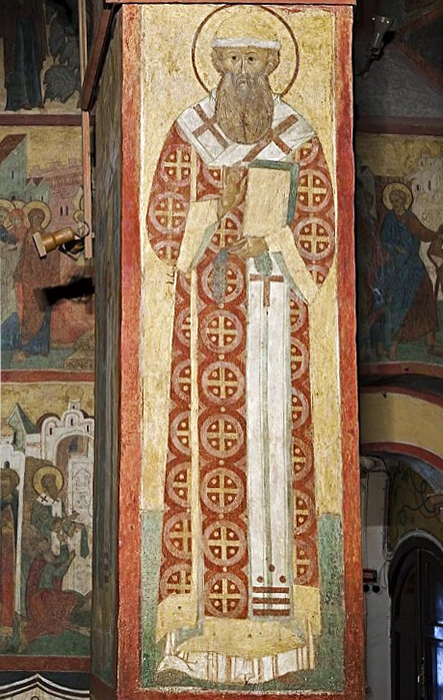
of the Robe, Moscow Kremlin
Shortly before his death, he was granted a vision of an Angel, who not only foretold his approaching departure but also indicated the time remaining for preparation. From the perspective of the theology of holiness, this is undoubtedly a special privilege granted to the righteous.
It is not entirely known how Photius appeared to his contemporaries. However, chronicles, documents, and letters create the impression that he seemed to have stepped down from an icon of the age of the Church Fathers. He was a monk by vocation and, from his youth, lived in obedience to an elder. He accepted his election as head of the Russian Church as an act of obedience and sought no personal advancement.
Formally remaining Metropolitan of Kiev – since the Moscow see did not yet exist at the time – he visited Kiev and in 1420 restored the weakened unity of the Kievan metropolitan see. It should be recalled that Lithuanian and Polish rulers were already attempting to install their own Metropolitan of Kiev, independent of the Russian Church.
After Photius’ death, Bishop Gerasim attempted to occupy his see. However, he was immediately drawn into the internal conflicts of the then Grand Duchy of Lithuania. Taken captive by local rulers, he was burned in 1435. This terrible and martyr’s death of the new metropolitan undermined the authority of the ruler, who, as a participant in civil strife, resorted to such an act in the hope of intimidating his opponents. Thus, Gerasim’s death ultimately had a reconciling effect in its consequences.
The next Metropolitan, Isidore, signed the Council of Ferrara-Florence in 1439, was expelled from Muscovy, and ended his days in Rome as Dean (i.e., senior member) of the College of Cardinals. After this, the Russian Church proclaimed its own independence. A council of bishops, independently of the Greeks, elected Bishop Jonah of Ryazan as Metropolitan.
Therefore, Photius should be regarded as the last hierarch of the Russian Church within the jurisdiction of the Patriarchate of Constantinople. It is significant and biblically beautiful that this final hierarchical gift of Constantinople to future Russia proved so authentic amid the apocalyptic circumstances of the time.
Historians still debate when exactly Photius was formally canonized. Yet perhaps there is no need for certainty on this point. The Church is a community of pilgrims on the way to the Heavenly Jerusalem. It believes that Photius, the “brother-loving beggar,” as Symeon the New Theologian (949–1022) called himself, dwells in the communion of saints and intercedes there for his fellow pilgrims, for the Church, and for the whole world.
St. Sergius of Radonezh
On the third day after the commemoration of Saint Photius, the Orthodox Church celebrates the feast of St. Sergius of Radonezh. The very expression “on the third day” is one of the most significant biblical and Gospel phrases. Among other things, it points both to the reality of the Lord Jesus Christ’s death on the Cross and to the all-conquering power of God’s intervention in the course of human history, manifested in His Resurrection.
On this day, July 18 (July 5, Old Style), 1422, thirty years after the repose of St. Sergius (the number thirty traditionally recalls the years of Christ the Savior’s earthly life before the beginning of His public ministry), the saint’s holy relics were uncovered. This took place in accordance with instructions given by St. Sergius himself in a mystical vision.
Throughout his life, Sergius lived in humility. This is not merely a figure of speech but a genuine characteristic of his personality. As his reputation steadily grew among his contemporaries, the saint sought ever more earnestly silence and solitude.
In the Orthodox tradition, the Divine Liturgy is intended to be a manifestation of glory. The splendor of Orthodox worship is expressed through the harmony of majestic hymns, rich liturgical texts, splendid vestments, sacred gestures, processions, blessings, and – perhaps surprisingly – through the almost complete absence of silence.
There is, however, another image of Orthodox worship – one that is almost unknown. Some of the objects that belonged to saint Sergius are preserved in the museum of the Moscow Theological Academy, located within the Holy Trinity–St. Sergius Lavra. These include liturgical vessels and vestments. Those who have visited the museum and seen the surviving objects from his lifetime have also encountered a different vision of Orthodox worship.
It is a liturgy of humility, a liturgy of solitude, a liturgy of powerlessness, a liturgy of withdrawal from the world. This humble liturgy – let us call it “the liturgy of St. Sergius”– finds visible expression in liturgical vestments that are almost utopian in their simplicity and in wooden Eucharistic vessels. It is also present in the monastery conceived by its founder as a place of solitude, a city of angels, and a place of hiddenness. The whole of Sergius’ life was a search for this biblical and profoundly Christian “utopian” ideal. After all, the word utopia literally means “no place”– the presence of something that simply does not exist in this world.
The Life of St. Sergius tells us that for a long time the number of his disciples never exceeded twelve, as though he had fashioned his monastery after the image of the Last Supper. The icon of the Holy Trinity, which emerged from the tradition of St. Sergius, had as its prototype the Greek icon of the Hospitality of Abraham, depicting the Patriarch and the three Angels. Once again, we find ourselves before a sacred meal.
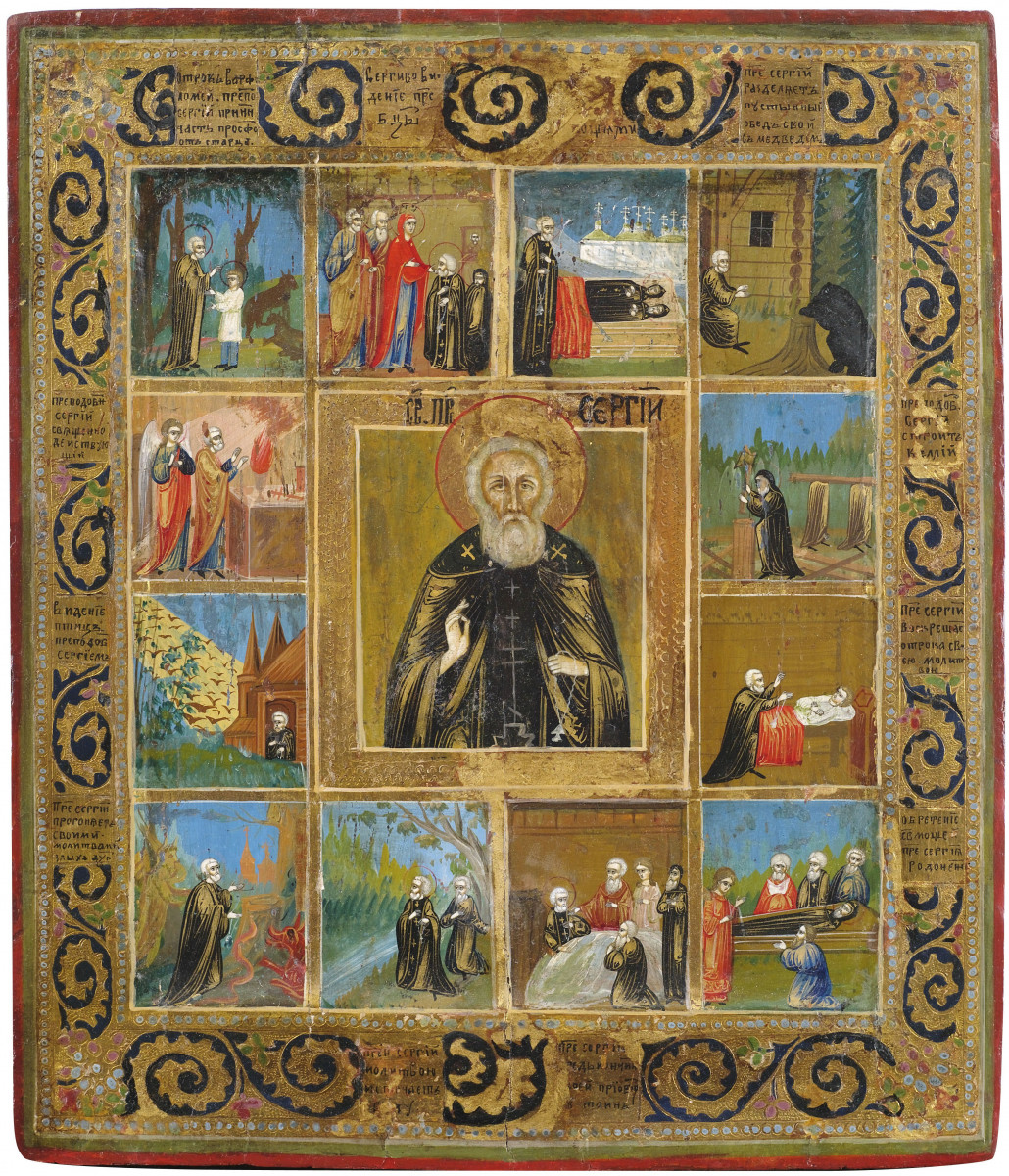
The Life of St. Sergius also relates that Metropolitan Alexius (1292–1378), then head of the Russian Church, wished to appoint Sergius as his successor. Sergius declined. On another occasion, his own brother attempted to seize authority in the monastery founded by the saint. Sergius simply departed.
In a vision, the Most Holy Theotokos appeared to Sergius together with St. John the Theologian. Beside Sergius stood his disciple Mikhei, of whom no one would ever have known had it not been for this vision. It is as though, on the eve of so great a visitation, Sergius himself did not wish to remain alone. Yet he chose to take with him neither a metropolitan nor an experienced ascetic, but a humble, simple, and timid monk.
The Life of St. Sergius was composed as a work of praise. Yet even the details that have come down to us often reveal the most remarkable and authentic truths. It is said that before his death Sergius did not wish to be buried in the church, as befitted the founder of a monastery. Instead, he asked the brethren to lay him to rest in the common monastic cemetery.
Broken Testaments is the title of a work by our contemporary Milan Kundera (1929–2023). In it, the great writer describes the wishes of authors and poets that were disregarded after their deaths for what was believed to be the greater good of humanity. Such actions may well be justified, yet they possess a profound and singular tragedy. After death, a person no longer belongs to himself…
With the support of Metropolitan Cyprian, the successor of St. Alexius, the monks buried St. Sergius not in the common cemetery, as he had requested, but in the church he himself had built.
According to the Gospel, Christ was baptized and began His public ministry at the age of thirty. Thirty years after his repose, St. Sergius appeared in a vision and commanded that his holy relics be uncovered. Thus began his glorification among the saints; Sergius himself went forth to preach.
He appeared to a simple man who sincerely loved him, lived near the monastery, and often came to pray at his grave. It is not known whether he had known Sergius during his lifetime. Perhaps he knew him only through the stories of his parents. Perhaps he himself had been born in answer to the saint’s prayers, like the biblical figures whose parents overcame barrenness through God’s mercy. We do not even know his name.
Yet it was to this man that Sergius appeared and said: “Tell the abbot that I am lonely beneath the earth, for I am surrounded by water. Why have you left me here for so long?”
St. Vladimir, Equal to the Apostles
On July 28, the Church commemorates St. Vladimir, the prince who became a remarkable embodiment of the meeting of peoples and cultures. A Varangian – a Viking by origin, and thus a son of the northern seas and the Baltic by birth; a Russian Slav by spirit; an heir to Greek and Roman civilization through his education; and a Christian by faith, he continues to inspire our historical memory like the Fair Sun – a symbol of enlightenment, mercy, and human fraternity.
In accordance with the Orthodox tradition of honoring those saints who brought Christianity to their peoples, he bears the title Equal to the Apostles. Following the practice of the ancient undivided Church in the West, it is equally appropriate to call the holy prince simply an Apostle. Thus, St. Vladimir is the Apostle of Kyivan Rus’, the Apostle of Eastern Europe, and, indeed, the Apostle of Russia.
About ten years after assuming sole rule, he resolved to embrace Christianity. Vladimir is venerated as a saint in both the Orthodox and the Catholic Churches, and his feast is celebrated throughout the Christian world. Was his canonization merely an expression of the Church’s and the people’s gratitude for the Baptism of Rus’ in 988, or did his other deeds also contribute to his sanctity, perhaps even bearing a prophetic significance?
Vladimir reigned from 978 to 1015 – thirty-seven years in all, twenty-seven of them after his baptism. If the chronicles are to be believed, he was born around 960, which means that he lived only fifty-five years. He spent the first half of his life as a pagan and the second half as a baptized Orthodox Christian. This striking division of his life into two equal parts is remarkable. It is a wondrous sign, a kind of biblical proportion, for God alone is the Lord of Time and the Author of Coincidences.
Today, the solemn celebration of the Baptism of Rus’ is associated with the commemoration of St. Vladimir. Before the Revolution of 1917, however, the Baptism of Rus’ was celebrated on August 14. This date coincides with the feasts of the Procession of the Life-Giving Cross of the Lord and the All-Merciful Savior. These are two medieval feasts of Constantinople. They would most likely have disappeared from the Church calendar had they not come to signify something greater. It was probably thanks to St. Vladimir and the Baptism of Rus’, these feasts were not only preserved in the Russian Church but continue to this day to be accompanied by the Blessing of the Waters.
The feast of the Holy Prophet Elijah, celebrated on August 2, also holds special significance in the Russian Church. This, too, indirectly points to the historical date of the Baptism of Rus’. The Feast of the Prophet Elijah has long been associated with prayers for rain and, in some places, with immersion in water. The Russian folk belief that one should not swim after St Elijah’s Day” may, beyond its folkloric significance, also allude to the theological truth that baptism is received only once in a person’s life.
The chronicles preserve the famous account of St. Vladimir’s search for the true faith. They relate that he rejected Islam because it prohibited the consumption of alcohol. Evidently, Vladimir feared the ritualization of everyday life and did not wish to impose dietary restrictions upon his people. He also rejected the form of Christianity preached by the Germans, considering it foreign because his ancestors had not accepted it. This proved to be a prophetic decision, for the “Christianization” of the Slavs by the Germans often ended in their complete assimilation.
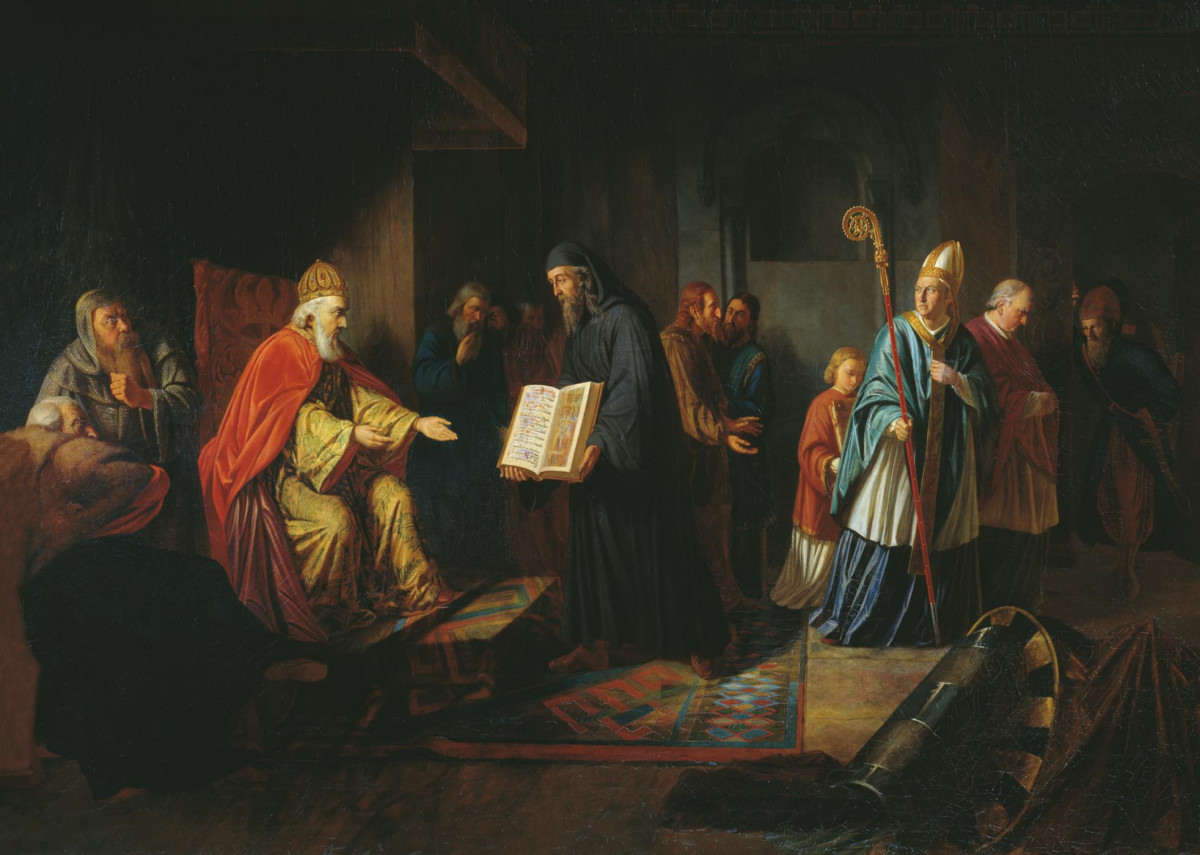
Judaism, which had reached Rus’ through the neighboring Khazar Khaganate, also troubled Vladimir, since the Jews had long before been expelled from Palestine by the Romans. The prince regarded this as an ominous sign. In the end, he chose Byzantine Christianity because of the splendor of the liturgy in Constantinople.
This detail is strikingly reminiscent of our own postmodern age, in which the aesthetic dimension of religion often assumes primary importance. “Beauty will save the world,” as Fyodor Dostoevsky prophetically wrote.
It is important to note that Vladimir’s decision to embrace Byzantine Orthodoxy was not motivated by a desire for power or by political calculation. “Your grandmother Olga was wise, and she has already made this choice,” told his advisers. “The Greek liturgy is magnificent, and we did not know whether we were on earth or in heaven,” the envoys confirmed. Such were the arguments in favor of Orthodox Christianity. This justification of the religious choice contains no reference to any dogmatic formulations. This means that Vladimir’s decision was neither dogmatic nor polemical. The choice of Byzantine Orthodoxy was not “anti-Catholic.” Constantinople was the City of Light, the center of world civilization, and Vladimir chose what was best for his people. The formal division of the Churches had not yet taken place.
It is therefore no coincidence that, after his baptism, Vladimir began to promote literacy among his people and to construct buildings and churches. Unlike many rulers of the past, for him Christianity was not the will to power, but a promise of enlightenment and social service.
The chronicles report that after his baptism Vladimir decided to abolish the punishment of criminals in the name of biblical commandments. This gesture may be seen as the creation of a prototype.
The first Russian saints were Vladimir’s sons, Boris and Gleb. After their father’s untimely death, they refused to struggle for power against their brother and were treacherously murdered. Their veneration began shortly after their death. However, they could not be canonized as martyrs since they had not been killed for the Christian faith. Therefore, in order to glorify them, the Church effectively created a new form of sanctity: the holiness of the innocently suffering, the sanctity of the passion-bearers. Thus was established one of the key characteristics of Russian holiness, without which it is impossible to understand either Russian history or the works of Dostoevsky and Tolstoy.
More than nine centuries later, the example of Boris and Gleb was followed by the last Russian emperor, Nicholas II, who was glorified by the Church precisely as a passion-bearer. Moreover, many of the New Martyrs of the Russian Church suffered not for their faith in Christ, but were killed without guilt, on fabricated accusations invented by their executioners. The rulers executed “presumed criminals,” although, like Vladimir, they should have stopped. In this lies the prophetic meaning of the holy prince’s refusal to punish criminals. It is a clear and extraordinarily powerful warning of biblical scale for all future generations.
The year 1988 became a turning point for the Soviet Union – only three years remained before the fall of the Communist regime. At first, the Soviet government did not plan to celebrate the millennium of the Baptism of Rus’, since the official state ideology was atheism and religion was regarded as a relic of the past. However, this decision changed abruptly. The Patriarch of the Russian Church, Alexy II, called atheism a “spiritual Chernobyl.” The Church was granted official permission to celebrate the millennium of the Baptism of Rus’. Moreover, the state itself actively participated in these celebrations. It was then that many people remembered for the first time that, through St. Vladimir, many nations had been baptized into the Orthodox faith.
The celebration of the millennium of the Baptism of Rus’ in 1988 marked a true return of Orthodoxy not only in Russia but throughout the world. It transformed Orthodoxy from a forgotten legacy of the past into an authentic Christian revival, the echoes of which became global, and whose fruits have filled the whole universe. The return to Orthodoxy had begun. We are all witnesses to this crown of miracles of the holy Equal-to-the-Apostles Prince Vladimir.