The 135th Birth Anniversary of Mikhail Bulgakov
The interview was conducted by Valeria Galkina
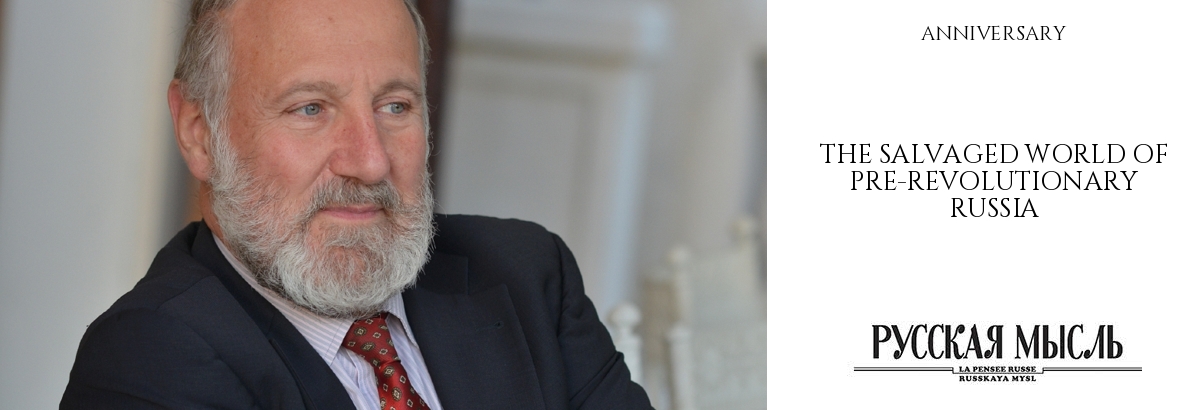
We have talked about the great writer’s life and work with his biographer Alexei Varlamov, rector of the Maxim Gorky Institute of Literature and Creative Writing in Moscow.
In your book, you called Mikhail Bulgakov one of the most incontestable and at the same time controversial Russian writers. Why?
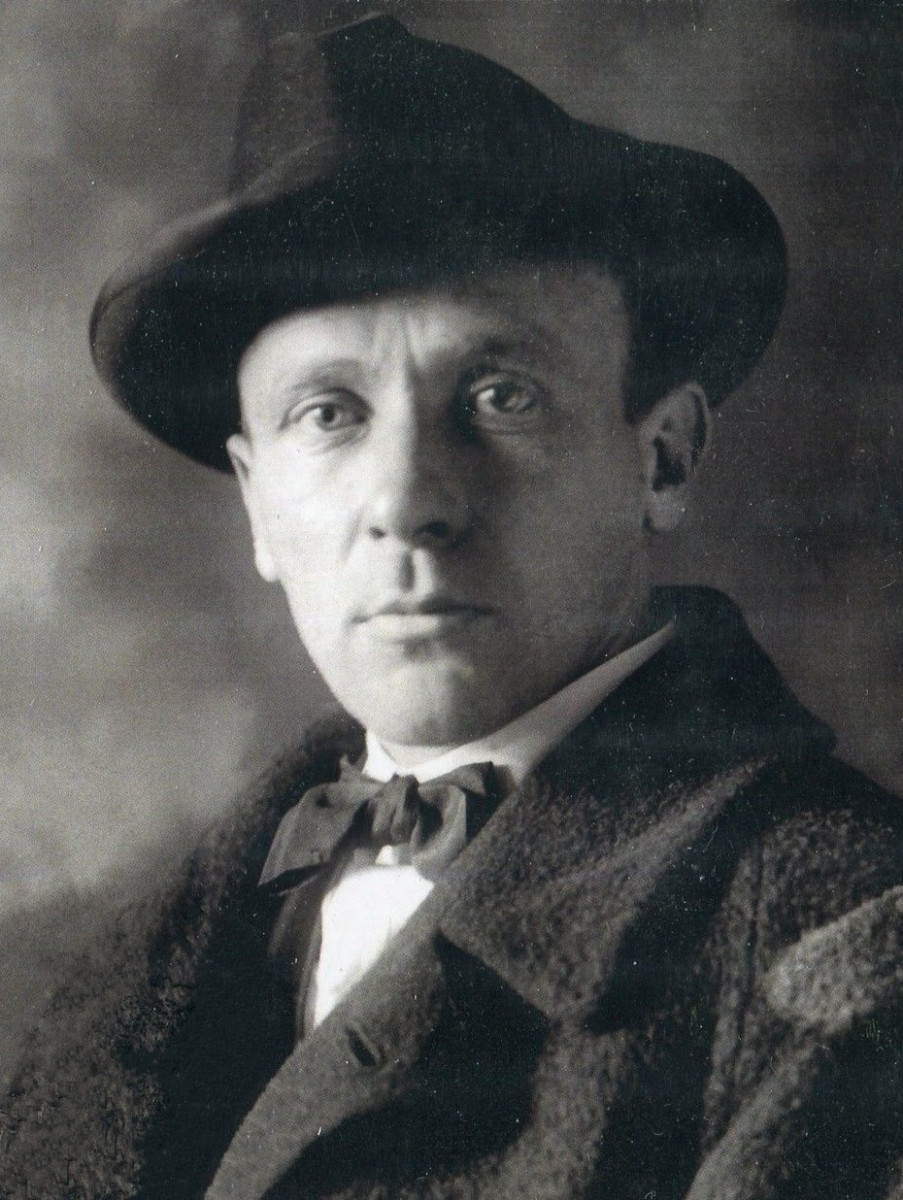
I believe that no one doubts Bulgakov’s absolutely incontestable reputation as a novelist and playwright. Regardless of how long a time passes and how the world around us changes, he remains an excellent and unsurpassed master of clarity, accuracy and brilliant writing, with an amazing ability to create vivid images and characters, with a fascinating intonation, musicality and poetry. As for his controversial themes, I was mostly referring to the audience of Orthodox, churched readers that I imagined when I was writing my book about Mikhail Bulgakov. True, there is something to argue about, disagree with and doubt here. And this applies not only to The Master and Margarita, but also to the play Flight, for instance. Or other controversial moments: the story of Batum, the interpretation of this play, the motives for writing it, as well as Bulgakov’s biography in general: his attitude towards Stalin, the «Prechistensky Circle» group, conflicts with the literary and theatrical communities, his family relations, the use of family ties as literary material…
When we talk about creative people, we often talk about the origins of personality, about childhood. Bulgakov was one of the few classics whose early life was very successful. How did it influence his worldview and creative work?
Indeed I wrote in my newly republished biography of Bulgakov about his happy childhood on “the most beautiful street in the world”, contrasting the difficult childhood of most Russian writers. However, we cannot be completely sure of the ultimate well-being of this period in Bulgakov’s life. Mikhail Afanasyevich was certainly very attached to his family, to his siblings, and to Kiev, which he loved dearly, but it is noteworthy that he himself wrote almost nothing about his childhood, adolescence and youth. Obviously, everything was not as cloudless as it might seem at first glance. We know very little about his relations with his father Afanasy Ivanovich Bulgakov, a professor at the Kiev Theological Academy; and young Bulgakov had many disagreements with his mother Varvara Mikhailovna, a very strong-willed and vibrant personality, which eventually led to open conflict. In fact, this conflict influenced the early departure of the future writer from the Church and the value system he was brought up in. And besides, Bulgakov could not forgive his mother her second marriage and it was no coincidence that he did not “include” her in his novel The White Guard.
Today The Master and Margarita is perhaps the most widely read work of Russian classics. What is the secret of the popularity of this novel? And what does it mean to you personally?
I can’t say that this is my favourite Bulgakov’s work. Rather, my choice is between The White Guard and A Theatrical Novel, which I simply adore as a rare piece of confidence, written not for fame, but for reading in a narrow circle and therefore especially nice, intimate and sincere. Conceived as revenge on the Moscow Art Theatre that rejected the writer and turned into a declaration of love for it.
But, beyond all doubt, The Master and Margarita is a magnificent and epoch-making book that once amazed and continues to amaze all readers around the globe. And the reader is right, because the reader is always right! Bulgakov invented a cool story, linking modernity with antiquity, mixing satire with romance, lyrics with sarcasm, malice with generosity, and sadness with fun, in such proportions that no one guessed what a hopeless and doleful story it really is – about the crushing defeat of man, about the weakness of good and the power of evil, and about Golgotha without the Resurrection. The author disguised this hopelessness, this narcotic vision of Ivan Nikolaevich Ponyrev, who only after a morphine injection sees what we read about with such delight, not realising in what anguish and fatigue Mikhail Afanasyevich was writing The Master and Margarita. Despite the visible laughter, there are lots of invisible tears in this book. But maybe this is why it is so attractive.
In your view, which works by Bulgakov were overshadowed by The Master and Margarita, without receiving due attention?
In general, Bulgakov would not complain now that modern readers do not know some important things about him. His works are being widely published, republished, translated, filmed, staged and studied. Of course, Bulgakov’s work as a librettist at the Bolshoi Theatre is less known, not all of his plays are equally popular, and most of the satirical articles he wrote for the Gudok newspaper have been forgotten, but this is understandable. All in all, we can say this: as unhappy and unfair as Bulgakov’s life was (with rare exceptions), the fate of his works turned out to be just as happy after his death. Another matter is that he himself saw it, knew it, had a premonition, and was enraged by this blatant injustice. He wished he could exchange the continent of his posthumous fame for bits of acclaim in his lifetime, but it was not given to him.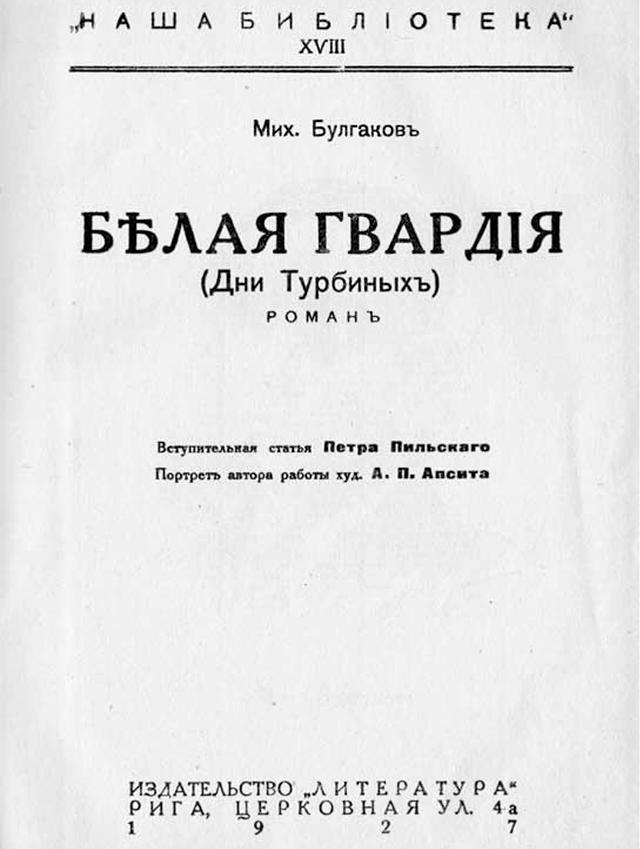
The subject of the writer’s contradictory relations with the authorities deserves special discussion. On the one hand, the ban on publication and harsh criticism in the Soviet press; and on the other hand, the patronage of Maxim Gorky and Joseph Stalin, despite the undisguised dissent… Can we say that he became a victim of envious people rather than a victim of the regime?
Bulgakov did not consider himself a victim of Stalin, the OGPU or censorship, but of Fate. He also blamed his own characters for his misfortunes, which was just in its own way. Not so many people envied him to consider him solely their victim. In the 1920s, when three of his plays were successfully performed in Moscow, there were surely enough enemies, and in the end, thanks to the Ukrainian writers who, at a meeting with Stalin in February 1929, demanded that The Days of the Turbins be banned, the “dark forces” achieved their goal, but unlikely out of envy. Two months earlier, when a group of Soviet playwrights headed by Vladimir Bill-Belotserkovsky tried to do the same, calling Bulgakov a “counterrevolutionary” and a “White Guard author”, Stalin ignored their denunciation and replied sternly: “Learn to write like Bulgakov, and then pester me with your nonsense!”
Actually, Stalin’s patronage was very short-lived and relative, and Gorky’s was even less so. At least Gorky contributed to the resumption of The Days of the Turbins in 1932, when the Ukrainian issue temporarily lost its relevance, but refused to publish Moliere’s biography, Bulgakov’s most feverish and autobiographical book, which meant a lot to him. Lastly, Gorky did not support Bulgakov in his desire to move abroad, just as Stalin did not help him here, and for Mikhail Afanasyevich the confinement in his «golden cage» in Moscow was a terrible blow and the disappointment of his whole life.
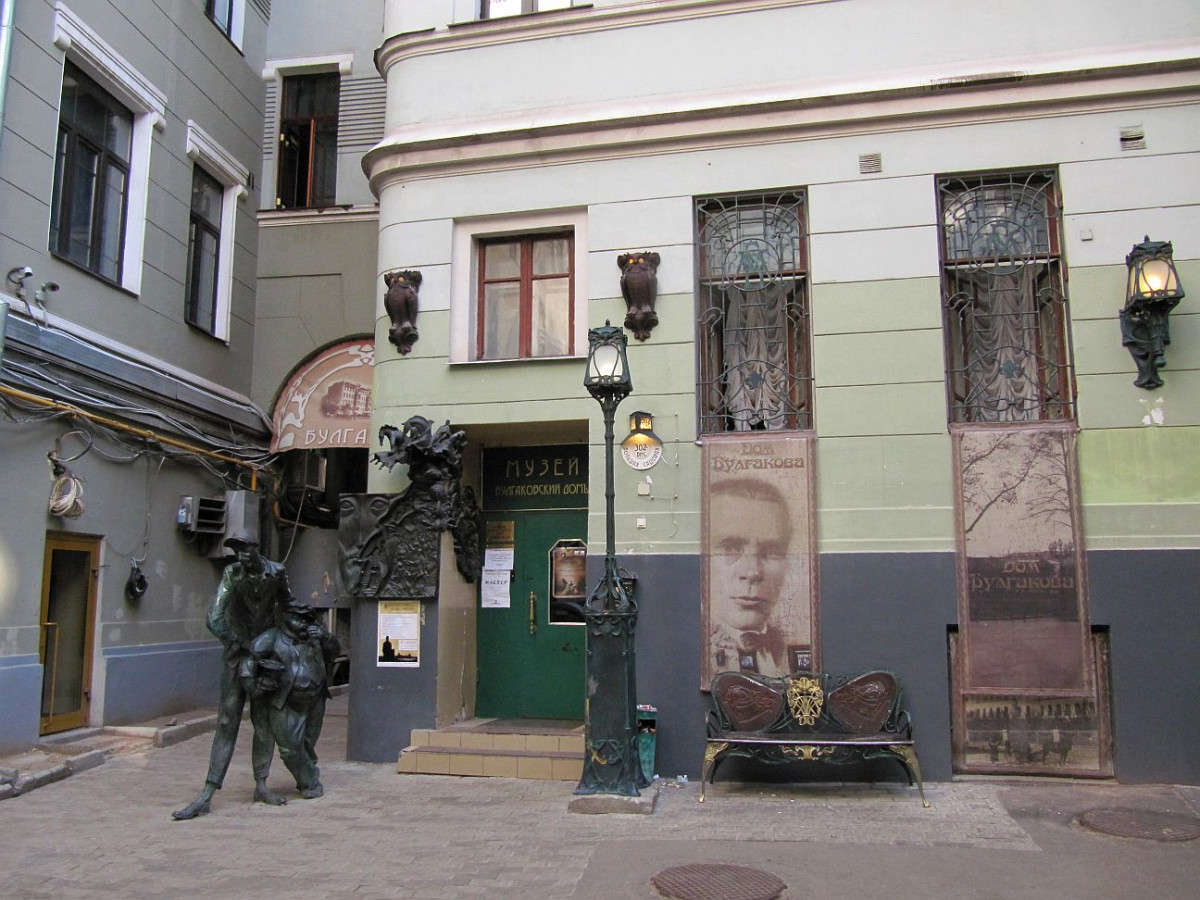
Mikhail Bulgakov’s works are widely adapted as films: not only in Russia, but also abroad. Which films do you find successful and which ones you don’t?
It seems that Vladimir Bortko’s film The Master and Margarita was not as bad as it was described. The cast was good, as were the camerawork and visual appeal. But this is such a fate: everyone considers himself a specialist in Bulgakov’s work, not least in the interpretation of The Master and Margarita.
I recently watched Alov and Naumov’s film Flight, which was once very popular, but apart from the scene where Ulyanov beats Evstigneev at cards and the amazing Dvorzhetsky as General Khludov, in my judgement, it does not look very convincing today. It is yesterday. As is Bortko’s Heart of a Dog, though when this film was first released, its fame was huge and well-deserved. But that’s probably the difference between literature and cinematography, because even good film adaptations age faster than their originals.
To my mind, the series based on The White Guard, filmed a few years ago, were no good in the first place, though the script was written by very talented people, the director is competent, and the cast is wonderful… but it’s impossible to watch. Vladimir Basov’s film was much better. Alexei Balabanov’s Morphine is a very interesting film, albeit it heavily distorts the idea of Notes of a Young Doctor, a triumphant and inspiring book, but Balabanov’s talent did its job. As for film adaptations that don’t age, I would mention Andrzej Wajda’s film Pilate and Others. Here’s a true classic, albeit made for television.
Another Drama
The State Youth Theatre on the Fontanka (St Petersburg) is Successfully Hosting Bulgakov’s Play ‘The Kabbalah of Hypocrites’
The theatre’s artistic director Semyon Spivak has abandoned the traditional interpretation of Mikhail Bulgakov’s famous play as the artist’s conflict with the government and dedicated his performance to the theatre’s life-affirming power.
No, no, it is not about the relations between the artist and the government. They are quite predictable: under any economic and political regime the government strives with all its might, firstly, to give the artist less than he deserves, and secondly, to take back its favours at the first opportunity.
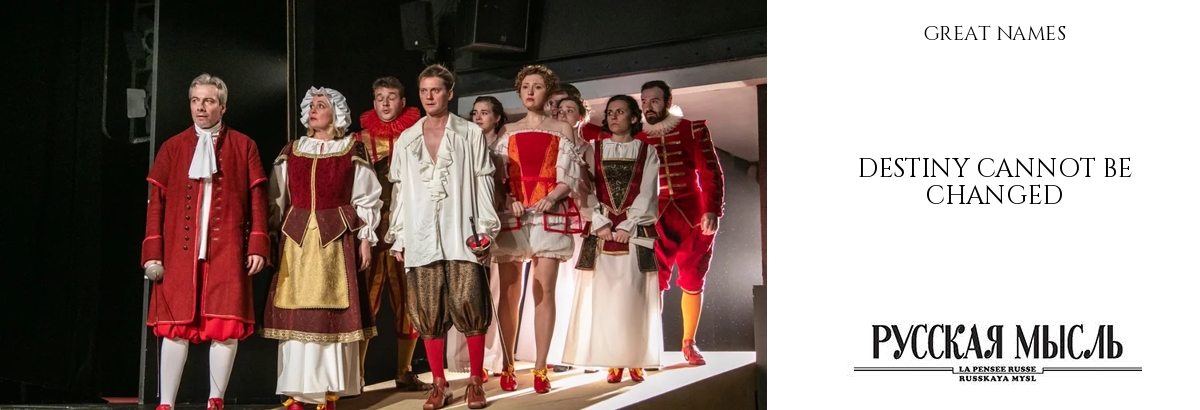
In Spivak’s version, Louis XIV (played by Andrei Shimko) doesn’t appear in the eighteenth-century royal robes, but in an elegant tracksuit and a swordsman’s «chain mail» over it – like a businessman of the highest level. And his retinue… A lackey is a lackey, whether in lace and satin or in an office uniform!
The elegant irony with which Sophia Zograbyan has dressed the characters of the play is praiseworthy. The costumes she has invented are actor-proof in the highest sense of the word. A Dell’arte-style blaze of colours in the outfits of the actors of Mr de Moliere’s troupe, the chthonic (infernal) dullness of the robes of the Kabbalists, and the blinding whiteness of the king’s «Hugo Boss» robes. The visual aesthetics of the play is not an «illustration» of the director’s vision, but a kind of «parallel» drama. Stepan Zograbyan’s stage design is executed as the rivalry of descents and ascents, which no mortal can avoid.
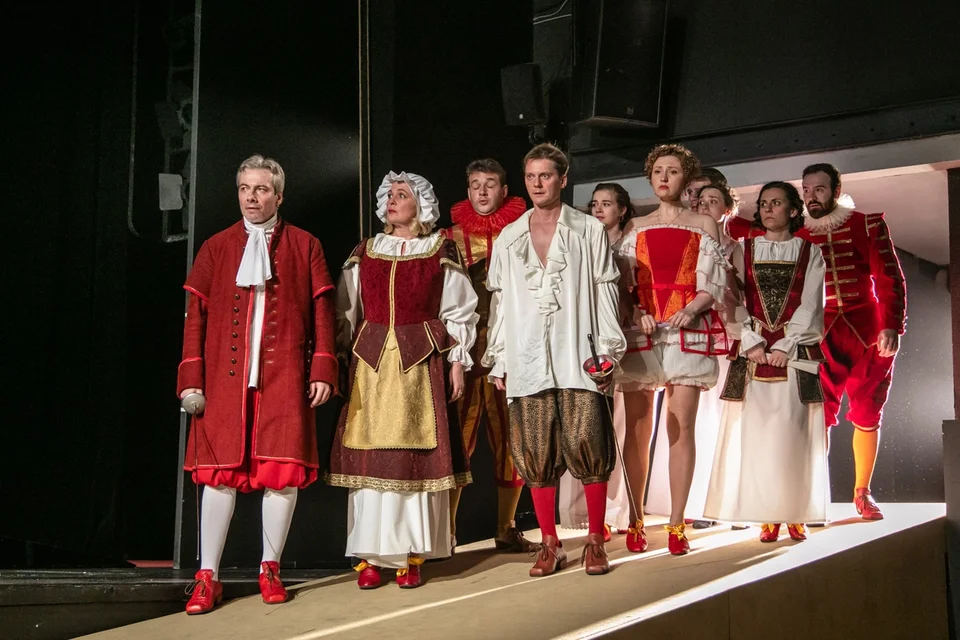
Jean-Baptiste continues to create even when all his dreams and hopes are in tatters. Sergei Barkovsky masterfully copes with the task set before him to show the viewer the main talent of his character – joie de livre. This love permeates everything he does, illuminating everyone around him. It is diverse and takes many forms: it is no coincidence that the ancients categorized love into as many as seven distinct types.
Agape guides Moliere in his relations with Madeleine Bejart (Svetlana Strogova) – extinguished human love has transformed into an unquenchable business partnership. Eros rules his passion for Armande Bejart (Anastasia Tyunina), the young source of his mature inspiration. Storge guides his attitude towards the troupe – his only real family. Ludus makes the comedian fight a fatal duel with the king and accept a deadly challenge from the indomitable Marquis d’Orsigny (Alexei Oding). Philia allows him to forgive Muarron (Sergei Yatsenyuk) who betrayed him. Lastly, for Moliere theatre has long become his mania – a divine madness, which he sacrificially serves till his last breath. But the point is certainly not what each type of love is responsible for in Moliere’s life, but that for him this life in itself is love. Joie de livre in all its manifestations.
Spivak does not try to blame the imperfect world and its even more imperfect inhabitants: human beings are human beings, and mercy sometimes knocks on their hearts… Actors become lawyers for their characters. Louis-Shimko cannot jeopardize the reputation of the royal power: as a human being he likes Moliere very much, but his marriage is unlawful, even if it’s not his fault. Archbishop Sharron (Roman Nechayev) has to uphold the honour of his uniform (that is, his clerical robes), so it would be strange to expect him to be enthusiastic about the accusatory witticism of Moliere’s «Tartuffe”. And d’Orsigny-Oding cannot help but take up his sword at the very thought that some buffoon made a joke about him, a descendant of a noble family, in his comedy: after all, in fact, he has nothing but family pride. But perhaps the most perfect fit for the role is the arrogant and handsome Muarron: Sergei Yatsenyuk seems to have spotted his character in a nightclub.
But let’s be absolutely honest: Jean-Baptiste himself is not sinless either. In fact, the retribution that overtook Moliere is the price for two destroyed lives – those of Madeleine, who, like any woman, wanted family happiness (when she says that a faithful dog cannot be kicked out into the street, your heart sinks); and Armande who grew up without a father.
Yes, Moliere has to fight «with a whole sea of troubles”. But what the director is primarily concerned with is not the outcome of the battle – it is a foregone conclusion – but the way Jean-Baptiste combats. Moliere may lose strength, his dignity may weaken for a while, but the belief that life is worth living never leaves him. In the play he does not die in front of the audience: we will never see what happens on the stage of the Theatre du Palais-Royal. But we will see how the «resurrected» master gathers his artists to bring them to the curtain call – the theatre exists as long as there are spectators in it. It is made for them.
By Victoria Peshkova