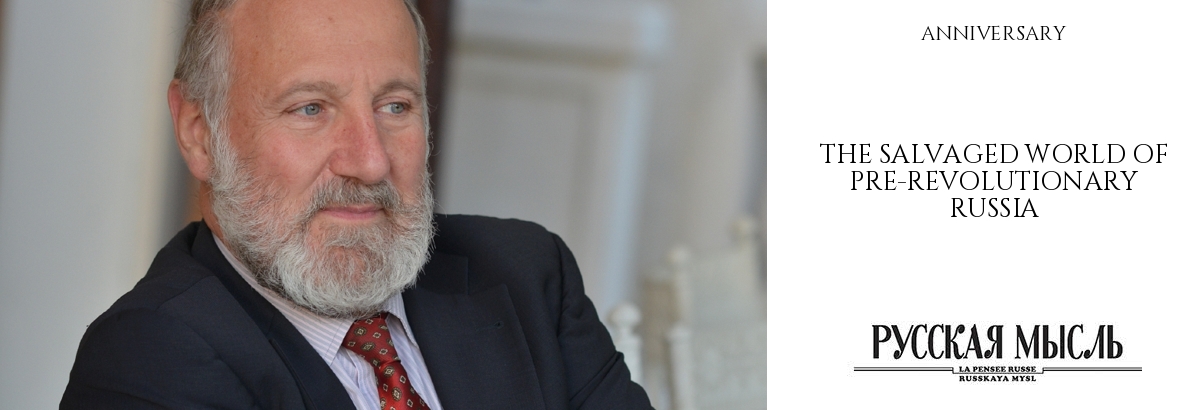
The editorial staff of the Russian Mind magazine greets the prominent French researcher and collector of the Russian emigration’s cultural heritage Rene Guerra on his eightieth birthday.
By Alexander Senkevich
I first heard the name Rene Guerra in the early 1990s in Paris from a parishioner of the Orthodox Church of the Three Holy Hierarchs and St Tikhon of Zadonsk, situated in the 15th arrondissement of Paris in a former garage. She enthusiastically told me about a man, the owner of a massive collection of paintings and books by Russian artists and writers, who had ended up outside their homeland. According to her, he passed himself off as a Frenchman, but his Russian language revealed him to be a native of Russia. He was rumoured to have come from Odessa. He might be a Romani baron or something, but certainly not a French intellectual…
I heard this mysterious story over thirty years ago in the wonderful city of Paris. As we can see, the legend of the Count of Monte Cristo is timeless.
Today, the saying by the English philosopher Francis Bacon (1561-1626), the founder of English materialism and Lord Chancellor under King James I, remains relevant: «Nothing so much prevents and retards a man from advancing in truth as a presumption of his own truth.»
Guerra’s books are published not only in France, but also in Russia. Thus, his book They Took Russia with Them came out in 2003, followed in 2010 by Seven Days in March: Conversations on Emigration, co–authored with Arkady Vaksberg; in 2015, About Russians in Russian came out, and in 2016 he co-authored Oh, This South! Oh, This Nice! Conversations on the French Riviera with E. A. Poltavskaya. This was followed in 2017 by the monumental work The Cultural Heritage of the Russian Diaspora with my preface, and in 2023 – by the ironic Franco-Russian Fanny in both French and Russian.
So what actually happened? How does a native Frenchman come to have such a magnificent, lexically rich Russian language, which makes some of my compatriots believe that he hailed from Russia?
Rene Guerra was born on 13 July 1946 in Strasbourg into a family of teachers. His father, Julian, a German teacher, and his mother, Jeanne, a math teacher, were originally from Nice. In 1952, the family returned to the land of their ancestors – the French Riviera.
It all began on an autumn day in 1957, when Rene, an eleven–year-old boy from a wealthy family, happened to meet Russian people – those whom the French called «White Russians» and regarded as outcasts. Interacting with his new acquaintances completely transformed young Rene’s worldview. He was struck by their warm hospitality, combined with a charming simplicity and delicate soulfulness. He grew attached to the Russians immediately and forever. Through them, he came to love not only their language and culture, but Russia itself – and not just for a short time, but for the rest of his life. Through direct contact with Russians and indirect discovery via books and paintings, he experienced the unique, heartfelt atmosphere of traditional Russian life, the joy of human understanding and the greatness of Christian love, humility and self-denial. The living world of pre-revolutionary authentic Russia rose up before him. And this Russian world had no spiritual connection to the USSR.
My guess is that a sense of compassion also helped spark an attachment to these outcasts. After all, they had suffered immense hardships and misfortunes. There is a whole story behind each name! And each of them, like no one else, proved through his life the poet Velimir Khlebnikov’s observation: «Art is the difference between someone’s happiness and our shared misfortune.»
I turn to the text of the Afterword that concludes volume 4 of Rene Guerra’s extensive study Artists of the Russian Diaspora and the Art of the Book: «I got the Russia bug at an early age when, by a twist of fate, I started taking Russian lessons. My first teacher was Valentina Pavlovna Razsudovskaya, originally from Kiev, and the second was the poet Ekaterina Leonidovna Tauber-Starova (1903-1987). She did not just teach me the language – she became my spiritual mother.»
Coincidence or not, genetic memory certainly played a part. After all, as Rene Guerra writes, his maternal grandfather, Ange, served as the majordomo to Ekaterina Dolgorukova, the morganatic widow of Emperor Alexander II. Meanwhile, his paternal grandfather, Ernest, the owner of a roofing business, installed the cross on the main dome of the Russian Orthodox St Nicholas Cathedral in Nice in 1912.
In Tibetan Buddhism the concept of «hidden treasures» (termas) refers to manuscripts and other sacred objects that have been safely concealed since ancient times in hard-to-reach caves of the Himalayan Mountains and the sands of the Gobi Desert. Human history sometimes sees times of vandalism and mass madness. Zealots of a new faith who come to power curse the old one and barbarically destroy all its signs, attributes and objects as useless and dead. Above all, with inhuman cruelty, they send representatives of an alien religious and philosophical tradition into oblivion. Yet the human spirit is indestructible, as are the treasures it creates. Seemingly lost forever, in the necessary historical moment, as if by God’s will, they mysteriously reappear in different parts of the globe.
In the 1960s to the 1980s, both in the USSR and in France, very few people took any interest in the artistic and literary heritage of the first wave of Russian emigration. Still less did anyone care about its creators, who were living out their days in oblivion and hardship on French soil. Without the guardianship of interested parties, these treasures – spurned by the majority of collectors – faced only one destination after their owners’ deaths: the flea market and the rubbish dump. There was as yet no fashion for Russian culture in exile back then. It emerged much later, during the final stage of Gorbachev’s perestroika.
Lola Zvonareva’s fundamental work The Silver Age of Rene Guerra, published in 2012 by the Rostok St Petersburg publishing house, tells the story of challenging conditions in which Rene Guerra salvaged books, magazines, manuscripts, paintings, and graphic works by outstanding Russian cultural figures who left Russia after the October catastrophe and what extraordinary people they were.
People may judge the work of our compatriots abroad differently when compared to twentieth-century masterpieces of world literature and art. Yet none of them can be accused of betraying their ideals and their life’s work. Their works are entirely free from haste, bias, or the mark of mere artisanship. They captivate with their individuality, good taste, and a sense of free spirit embodied in words, colours and lines.
I feel a certain awkwardness when I hear lamentations regarding the supposed intellectual and artistic decline of the Silver Age geniuses who ended up in foreign lands. To this day, a misconception – or, more precisely, an ideological prejudice – exists that leaving your native shores signifies the inevitable loss of national identity and, consequently, is fraught with creative sterility. This view on the nature of creativity has deep roots. This idea took hold in the Soviet mindset, taking on a distinct xenophobic tone. Meanwhile, such conclusions are not supported by facts. It is widely known what outstanding achievements in science and culture were made over the past century by representatives of the Russian diaspora.
Zvonareva’s book contains Rene Guerra’s comment on Zinaida Gippius’ idea that «the Motherland is dearer and above all else, but without freedom there is no motherland.» The French slavist is right in his conclusion that this stance of Gippius «found visible confirmation» and that «this is the most important lesson the emigration taught and left to posterity.» He reaches a firm conviction: «Virtually the entire Silver Age migrated abroad. It turned out that you could take both Russia and freedom with you, whereas in unfree Russia, Russia itself did not exist.»
Rene Guerra’s collection work, which continues to this day, stands out for its wide reach across diverse literary and artistic materials, as well as the immense effort spent searching for them. It is hard to imagine how one man managed not only to raise this sunken Kitezh [a mythical, invisible city said to be beneath the waters of Lake Svetloyar in Russia. The word “Kitezh” is often used figuratively to symbolise a lost or hidden spiritual ideal]of the outraged Russian spirit from the depths, but also to restore it in all its human and artistic rights.
For many of Guerra’s colleagues – French Russianists, mostly of leftist leanings – it was a road to nowhere, the whim of a wealthy French good-for-nothing who had learned to speak fluent Russian and was trying to act as an advocate of «exploiter-monarchists», some phantoms and literary ghosts long since written off and dumped on the ash heap of history. Now, with this road more than half travelled, history has unexpectedly confirmed Rene Guerra’s intuitive wisdom and rightness.
So what is this wisdom like, as interpreted by Lola Zvonareva, a researcher of Rene Guerra’s work? It is valid to consider that the Silver Age of Russian literature consisted of authors who held diverse views on the world and art. Despite the rivalry of various literary groups, within this conglomerate of opinions and preferences there existed a common, unifying bond: respect for the national Russian tradition. As N. S. Arsenyev wrote: «A living tradition and a personal feat, a striving forward and a deep rooting in the past and in the depths of the life of the spirit constitute one single whole – a single impulse, a single stream, a single powerful current. In order to participate fruitfully in the life of your nation and influence it, you must know what gave birth to its highest achievements and treasures, and yourself assimilate these creative, awakening, and fruitful forces.»
Out of the a priori necessity for this cultural, historical, and religious continuity grew Rene Guerra’s deep conviction that spiritual slavery – which kills the conscience and the living essence of rational man – cannot be eternal, for it opposes the laws of evolution, as well as the very meaning and course of life. In the Soviet Union, the authorities’ assault on the Russian spiritual tradition aimed at least at the constant desecration of ancestral faith – Orthodoxy – if not its complete destruction.
The term the «Silver Age» was introduced into critical discourse by the first-wave émigré literary scholars Nikolai Otsup and Vladimir Weidle, with the most significant aspect being the logical and rightful claim of the Russian literary diaspora in France (and elsewhere) to act as the successors and guardians of the Russian spiritual tradition.
In all fairness, however, we should note that certain Russian literary classics were published in huge print runs under Soviet rule. This paradox of ideological policy in the totalitarian USSR still awaits explanation.
Arriving in Moscow in 1968 as a Slavic studies trainee, Rene Guerra fell in with his intelligent and free-thinking peers on the one hand, and under the watchful eye of the «competent authorities” on the other. After all, he had been welcomed into the circle of «White Russians», representatives of the first wave of emigration – something his Communist-leaning teachers were not supposed to suspect.
Guerra grew particularly close in France to Boris Konstantinovich Zaitsev and, at his request, brought three copies of his book The River of Times to the USSR. It was a unique literary testament by the writer. The copies were intended for K. I. Chukovsky, V. P. Nekrasov, and L. N. Nazarova, an employee of the Pushkin House. Of course, the books were delivered to these people, and the «courier» became a target for the KGB as a «hardened ideological saboteur.» All the twists and turns of the plot of «the KGB and Rene Guerra» are detailed by Lola Zvonareva in her book with such precision that they resemble the outline of a spy detective story. It features a candid confession by K. I. Chukovsky, along with his reflections on the nature of Soviet power (at the writer’s request, Guerra recorded these revelations on a tape recorder); the tracking and final exposure of the foreign wrongdoer; and the direct oversight of this entire operation by the USSR chief ideologue M. A. Suslov… And at last, a triumph for the KGB: the confiscation of the ill-fated tape recording from Guerra’s wife at the border and the prompt expulsion of the French «agent provocateur». It is like a gripping television series, featuring the defamation of the «villain» right there in France, the spread of tall tales that he is supposedly the son of a fugitive Russian princess named Gerasimov, and – in social life – a KGB operative…
Throughout the history of collecting, there is arguably no one who has opened their soul so wide to a foreign culture, felt such deep sympathy and offered such help to its creators, and so methodically, year after year, searched the world for all things Russian… Books with authors’ signatures, magazines, newspapers, letters, postcards, manuscripts, works of painting and graphic art, everyday objects. For Rene Guerra, the very process of hunting for rare items happens as if by the way and takes on an almost mystical character. Many of his significant acquisitions of recent years have come to him «by chance”.
The absence of funny and seemingly implausible stories in the book about how new treasures keep finding their way into the reserves of the French collector is perhaps the only significant gap in Lola Zvonareva’s study.
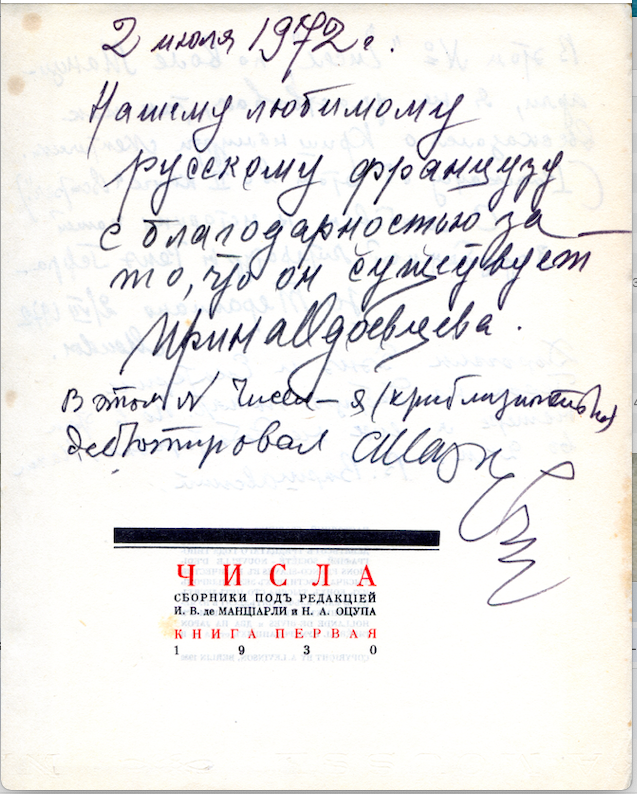
Most of Lola Zvonareva’s book is dedicated to the «White Russians» – those «last of the Mohicans». Since Guerra did not meet many of them, he collected everything related to their lives and work with special zeal. In 1971, he acquired a flat in Meudon, a Parisian suburb, where wonderful Russian writers and artists constantly gathered around his dining table. Among them were M. F. Andreyenko-Nechitailo, Yu.P. Annenkov, D. D. Bushen, V. S. Varshavsky, A. E. Velichkovsky, Ya. N. Gorbov, N. A. Isayev, N. N. Obolensky, I. V. Odoevtseva, G. E. Ozeretskovsky, A.V. Rovskaya, G. A. Rubisov, E. F. Rubisova, E. L. Tauber-Starova, Yu. K. Terapiano, S. I. Sharshun, I. P. Shuvalov, and S. R. Ernst.
Short essays on prominent figures of the first wave of Russian literary and artistic emigration in France – whose books, magazines, manuscripts, archives, and paintings are housed in Rene Guerra’s collection – lend great persuasive force to the indisputable fact that we are dealing not merely with an outstanding private collection, but with a unique, one-of-a-kind museum.
The illustrative material in The Silver Age of Rene Guerra is striking. It features hundreds of reproductions of books, illustrations, photographs, postcards, portraits, autographs, and personal inscriptions from writers, many addressed directly to Rene Guerra. Finally, Zvonareva’s poetic album – a special appendix featuring poems dedicated by Russian exiles to their French friend – deserves mention. The appendix also features a selection of articles about Rene Guerra by various authors and a meticulously compiled bibliography of his own books, articles, talks, and interviews, as well as books and articles containing reviews of or references to his books, articles, publications, public speeches, and activities.