
Everything Jesus Christ said and did during His earthly life was an unadulterated, direct divine revelation By Augustine Sokolovski, Doctor of Theology, Priest
LEAVETAKING OF PASCHA
On the fortieth day after the Resurrection of the Lord Jesus from the dead, the Church concludes its celebration of Easter and bids farewell to the season. Like any period of time, it was not easy. It unfolded in an alternation of prayer and daily life, thereby creating the uniqueness of the believers’ fellowship.
Parish life and the unique interweaving of the saints’ commemorations with the moments of the Paschal calendar have, unwittingly, contributed to the Leavetaking of Easter as one of the observances of the liturgical calendar.
New Easter celebrations await every believer on this earth, but their number is limited, for all of them, like the times and years of each person – those “hairs on the head” from the Sermon on the Mount – are numbered by the Lord Christ. For some of us, Easter on earth will never be repeated.
Thus, human life is reflected in the structure of the Paschal season. We turn to time because, for people of faith, time is not merely a chronology – a hopeless march toward inevitable passing – but rather the very frame, the very context, within which the Lord Himself once appeared. Thus, time becomes one of the names of God. For He, being outside of time, became temporal. According to St. Augustine (354–430), the “inventor of time” in human thought, He Himself became time, entering into history to free us from time.
The days of Easter serve as a reminder of this great liberation. They become a wondrous attempt to escape, through liturgy and prayer, into the eternity of God, where Jesus seats at the right hand of the Father.
In this sense, the celebration of Easter does not end, but continues in the Ascension of the Lord, reaching its culmination in Pentecost. For the Descent of the Holy Spirit is the proclamation of Easter to the entire universe; it is Christ’s Easter, given to each and every one, to the whole Church as the Community of Believers, and to each of us. God will never abandon humanity, neither here nor, all the more so, there in the Kingdom of Heaven, where those who have accepted Him will reign on the thrones of the Apocalypse. Christ is Risen. We thank the Lord for His Passover, for His indescribably great Easter gift.
ASCENSION OF JESUS
Preachers often speak of the Ascension as a sorrowful event. As if the Apostles were left in a state of confusion and bewilderment, going through a period of repentance during the ten days between the Ascension and the Descent of the Holy Spirit at Pentecost. This is not the case at all.
The Ascension is a glorious event. It is the culmination of a great achievement that is both divine and human. Indeed, if we think in terms of metaphysics – that is, a kind of philosophy beyond philosophy – then everything becomes clear. God became man, was glorified, and ascended into Heaven.
But if we set aside metaphysics – which is, after all, a human construct – it becomes far from obvious that the Almighty, the Great, Boundless God, having become human, will lead this human life successfully: He will not destroy human nature, will not overstep human boundaries, will not be capricious or irritable, will not sink into indignation, nor, conversely, will He remain indifferent and submissive to any circumstances. Outside the realm of metaphysics, anything could have happened.
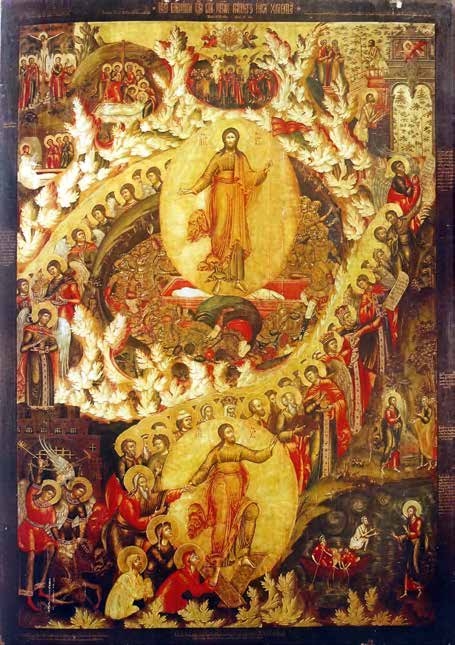
But it turned out that even this was, in fact, inconceivable. For man was originally created in the image of God, and God is the true archetype of every human being – and thus the future of humanity – so that this compatibility between God and man was revealed in a most excellent way. The union of God and man in Jesus Christ proved to be amazing and magnificent. God is the future of humanity; The Ascension is the mystery of the great compatibility between God and man.
In Jesus, true humanity was revealed: there is no one more beautiful, more wonderful, more kind, more magnificent, more blessed, more joyful, or more religious and devout. The culmination of this reality was realized in the Ascension. For the Lord Jesus not only rose from the dead, but, having gathered around Himself His original Church – the Apostles and the Myrrh-bearing Women – He blessed them and ascended.
Jesus ascended in glory. Let us imagine: He ascended in glory. Our beloved Teacher, the Lord Jesus, ascended in glory. Lightly and freely, like a bird, like the eagle of biblical symbolism found on coats of arms and emblems, yet with human dignity, magnificently and solemnly, He ascended into Heaven. He did not simply rise and ascend, but, as the Scriptures and the Creed testify, He ascended into Heaven and sat down at the right hand of God’s majesty in Heaven. This means that a human heart beats within God. This is the eternal truth and the dogma of the Christian faith.
For believers, this is a stark warning. For we are unable to truly be human beings; we are in no way able to truly embody our humanity. For example, we are dissatisfied with our age. We would like to live in a different era or time period. Those with overly liberal values would like to live in an era of great freedoms, while the more conservative among us would like to be incarnated in the Middle Ages. The other cannot become human, because he constantly behaves like an animal. Not because animals are bad in any way. On the contrary, they are properly incarnated because they humbly conform to what God intended for them.
The Church, as the Community of Believers, asks God to send us the Holy Spirit so that we may truly become flesh, that we may become authentic human beings. For only through true incarnation and humanization will a person be able, at the end of history, at the Second Coming, to ascend worthily and dwell with God in Heaven, where the Lord Jesus already dwells in glory and constantly intercedes for us, as our Friend and Brother, so that what was accomplished in Him may be accomplished in us. Christ has ascended into Heaven!
Fathers of the First Ecumenical Council
The seventh Sunday after Easter is unique. Unlike other Sundays in the church year, it is dedicated not to the Resurrection itself, but to the memory of the Fathers of the First Ecumenical Council.
The First Ecumenical Council was held in 325 during the reign of Emperor Constantine in the city of Nicaea. It was originally planned to be held in Ankara, or Ancyra – a name meaning “anchor” – the modern-day capital of Turkey, but was moved for logistical reasons. This change of venue turned out to be providential. For that time, an event of such magnitude – coming after centuries of persecution – was unprecedented, the first of its kind in history, and truly exceptional.
An Ecumenical Council is a gathering of the episcopate of the Churches within the Roman Empire, as well as certain bishops from beyond its borders, invited to participate by the emperor himself. This gave the Ecumenical Council a legislative character. The Roman Empire referred to itself as the “Ecumene” (Greek for “universe”).
The First Ecumenical Council adopted twenty canons – rules of immense importance for the life of the entire Church. Yet, unfortunately, few people today, even among the most devout believers, remember or know their content. The main practical decree of Nicaea was a single rule regarding the celebration of Easter, which to this day, in one form or another, is followed by all of Christendom.
Most importantly, the Council of Nicaea adopted the Nicene Creed, which solemnly proclaimed that the Son of God, who became man in Christ Jesus, is consubstantial with God the Father. This meant that the Son of God has always existed. He was not created, and there was no time, or any period before time, when He, the Son of God, did not exist or was not. This is a binding dogma of the faith.
The paramount importance of this dogma lies in the fact that only in this way can we be certain that everything Jesus Christ said and did during His earthly life was an unadulterated, direct divine revelation. We are saved by God Himself, Who entered history, lived among us, and became our Friend and Brother. In Him, salvation is certain and is granted to us absolutely and for all eternity. Faith in the divinity of Jesus Christ is a distinctive feature of Christianity.
The commemoration of the Fathers of the Ecumenical Councils during the annual liturgy, as well as throughout the year, is a distinctive feature of Orthodoxy. Let us strive to remember this. The significance of the Ecumenical Councils lies in the fact that they emphasize the essence of apostolic Christianity not merely as morality or doctrine – which is also important – but as Dogma. This also distinguishes Christianity from Judaism and Islam.
The Orthodox Church recognizes seven Ecumenical Councils. The First Ecumenical Council is exceptional and the most important.
Saints Cyril and Methodius, Apostles of the Slavs
This year, the feast day honouring the Fathers of the Council of Nicaea coincides with the commemoration of Saints Cyril and Methodius, the Apostles of the Slavs, on May 24.
For some time, brothers lived as monks in the same place, on Mount Olympus in Bithynia, in the same region as Nicaea, in Asia Minor.
Saint Cyril lived 42 years and died in 869 in Rome. He was a teacher, theologian, and philosopher. Methodius was twelve years older than his brother, lived to be seventy, and died in 885. The first Slavic archbishop in history, he was not subordinate to German hierarchs, as might have been the case at that time, but was ordained in Rome and became the head of an autonomous Orthodox Church in Moravia.
May 24 is also a church holiday commemorating the founding of Constantinople in 330 AD by Emperor Constantine the Great. Historically, it was this city that was destined to become the capital of Universal Orthodoxy from the moment of its founding until, perhaps, the upheavals of modern times: the Russian Revolution of 1917, the collapse of the Ottoman Empire following its defeat in World War I, and the expulsion of the Orthodox population from Asia Minor and Turkey in 1922, known in history as the Asia Minor Catastrophe.
The Feast of the Foundation of Constantinople is marked in the church calendar and has its own troparion, which is sung in the fourth tone: “The City of the Mother of God dedicates its foundation as a gift to the Theotokos. For it was created to dwell in Her. Through Her it lives and is strengthened, crying out to Her: ‘Rejoice, hope of all the ends of the earth!’ It follows from this hymn that ancient Orthodox hymnographers regarded Constantinople as the “City of the Mother of God.”
The coincidence of the founding of Constantinople with the feast of Cyril and Methodius is no accident. The feast was introduced by the Bulgarian Orthodox community in Constantinople in the nineteenth century on this very day with the aim of “replacing” the “Greek celebration,” thereby emphasizing the distinctiveness and self-sufficiency of Slavic Orthodoxy in response to what was then perceived as the dominance of the Patriarchate of Constantinople.
As is often the case in history, the original reason for the establishment of a particular tradition has been forgotten, while the Church has gained a wonderful celebration. As “Day of Slavic Literature and Culture,” Cyril and Methodius were celebrated in the last century even in officially atheist Slavic states.
Like the flower from Andrei Platonov’s children’s fairy tale, theological truths literally sprout through the concrete and asphalt of impenetrable secularism.
Pentecost
Fifty days after Easter, the Church celebrates Pentecost. In the Russian Church and in the Churches that have shared a particularly close history with her, this feast is called the Day of the Holy Trinity. This means that the feast was renamed at some point in history. As is often the case with tectonic shifts in ecclesiastical and liturgical life, there may be at least two reasons for this: a historical one and a theological one.
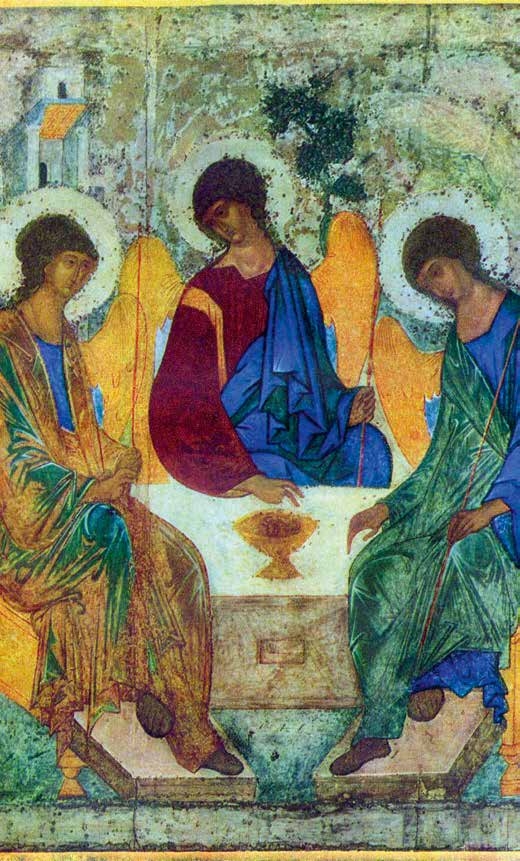
The fact is that Saint Sergius of Radonezh (1314–1392), the reviver of spiritual life in Russia, dedicated his monastery to the Holy Trinity. He celebrated the monastery’s patronal feast on the Day of Pentecost. From this practice, which became a great tradition, the famous icon of the “Holy Trinity” was subsequently created. It should be noted that in Greece, it is historically referred to not as the “Holy Trinity,” but as the Hospitality of Abraham. The icon as theology is, as it were, contrasted with the icon as event in these different Orthodox traditions.
The historical reason why Pentecost became Holy Trinity Day in the Russian Church is that, also during the time of Sergius of Radonezh, Russia was fighting for liberation from its subjugation to the Eastern empires, whose rulers had recently converted from paganism to Islam and had become much less tolerant toward the Orthodox.
The Feast of Pentecost, having become Holy Trinity Day, underscored the theological foundation of Orthodox Christianity.
This year, the Feast of Pentecost marks two remarkable coincidences. One of them can be described as historical, and the other as theological. According to the liturgical calendar, on this day, May 31, the Church commemorates the Holy Fathers of the Seven Ecumenical Councils.
In the Orthodox understanding, the Fathers of the Councils revealed to the whole world that Pentecost – as the life of the Holy Spirit in the Church – did not end with the era of the Apostles, but continues to live on in the Church’s decrees, in its moral life, and in its dogmas. This is a theological coincidence.
Another coincidence is that Pentecost coincides with the last day of spring. This is a reminder to us that the Spring of the World has ended. We have entered the last days. Great trials await the Church, but also great joy as the Second Coming of Christ draws near.
Spring is over. Most of us Orthodox believers are “Adult Men,” to borrow the title of Jean-Paul Sartre’s (1905–1980) novel of the same name; we are living in “The Age of Reason.” Therefore, both individually and as a whole, let us – the Church, as the Community of Believers – remain spiritually vigilant, watch over ourselves, and strive to correct our ways and improve, so that the Lord may return more quickly to those who await Him in deed and word.
Religion is a matter for adults, a source of blessing for life and the world; thankfully, to guide us on this path of virtue and service Jesus has given us the Holy Spirit.
Leavetaking of Pentecost
On the seventh day after the celebration of the Descent of the Holy Spirit upon the Apostles, the Orthodox Church celebrates the end of Pentecost. Thus, including the feast day itself, Pentecost lasts exactly seven days.
Starting the day after the end of Pentecost, All Saints’ Sunday, a new count of Sundays begins. Thus, All Saints’ Day marks the beginning of a new count of Sundays – 33 in number, corresponding to the number of years of Jesus’ earthly life – which will continue until the start of the Sundays leading up to Great Lent.
This marks the beginning of a new liturgical cycle, a fresh start – the perfect time for Christians to wish one another a Happy New Church Season and Happy New Year!