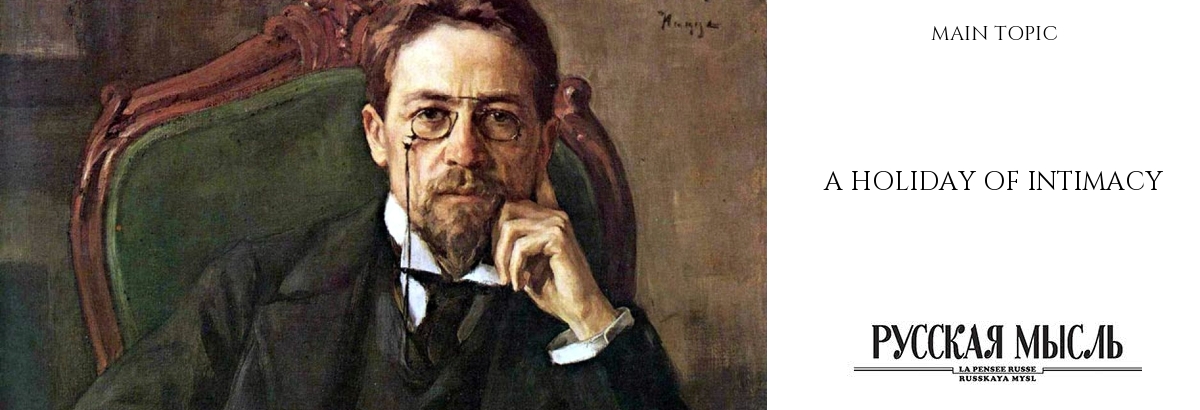

For the 190th anniversary of the birth of the famous American writer, journalist and public figure Mark Twain
By Alexander Baltin
Mark Twain is popular in Russia… It has always been the case, as though there were a Russian Mark Twain phenomenon.
Samuel Langhorne Clemens once worked as a boat pilot on the Mississippi River. His famous penname was originated from the cry «mark twain!», which meant two fathoms deep, the minimum depth of the river for a vessel to navigate safely.
There was also a trip to Russia in his biography…
In the summer of 1867, an American delegation visited the Crimea, a pearl of our planet, which attracts so many people; Samuel Clemens was part of the delegation…
Twain visited Sevastopol, Yalta, Livadia, Oreanda and the legendary Odessa, saturated with a special flavour; and preparations for that cruise had lasted several months, beginning in the winter of the same year.
The final destination of the voyage on the Quaker City steamer (while visiting a number of countries) was Palestine.
At that time Twain was still a little-known American journalist (rather Clemens than Twain), who, however, possessed excellent natural wit and an inexhaustibly ironic attitude towards life, which always helped him.
He himself suggested to the publisher of the Alta California newspaper in San Francisco to send him on a cruise, promising him to write plenty of essays about everything that was happening there, sparkling with fun and playing with the edges of sharp satire. Even fifty essays over a five–month tour, if needed. Thus, he won over the editors who paid for his trip.
The ocean was breathing heavily… The 1800-tonne steamer departed from the port of New York for a six-month voyage. It was expected to visit many places in Europe and the East, promising unforgettable impressions.
Constantinople, a city scourged by history, would open up. Here the group of Americans would split up: many of them would remain in the former capital of the Byzantine Empire, which once fell under the onslaught of the Ottomans. Twain was among those who sailed further to Russia.
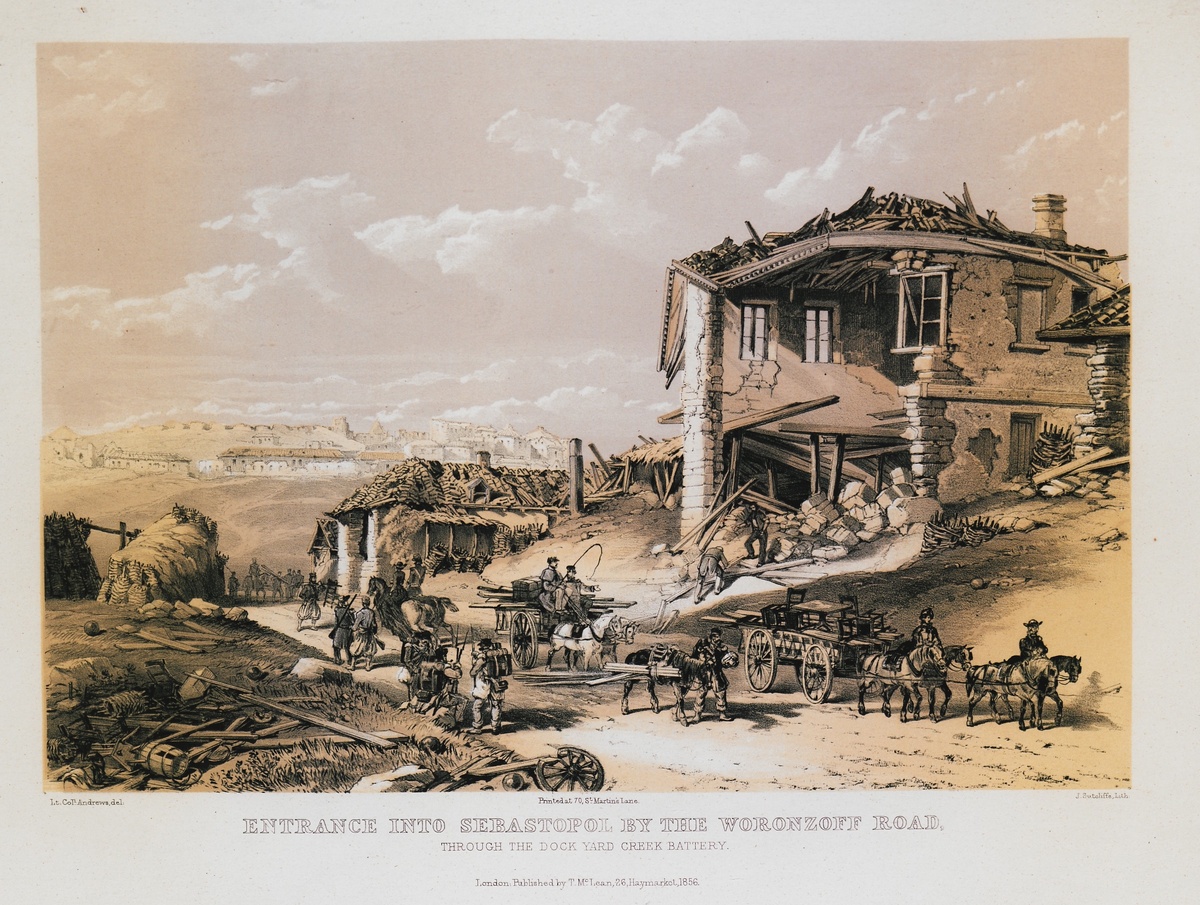
The first stop was in Sevastopol: a city that had not yet recovered from the events of the Crimean War that had raged here for three years.
The moored American steamer excited the city, because in those days few Russians travelled to America, and it was interesting to look at Americans.
An officer specially sent by the governor greeted the guests and invited them to the city. “Make yourself at home!”
The city, turned into a lacework of ruins in many places by the war, made a strong impression on the future classic writer; he wandered about alone, as if trying to “decode” Sevastopol, figure out the city’s code and its ways.
After visiting the fortifications of Sevastopol, at the site of the Nikolai battery where American volunteer doctors had helped wounded Russians during the defence of the city, he picked up several cannonballs and kept them at home as souvenirs for the rest of his life.
Demolished side walls of buildings, houses split in half, cannonballs stuck in walls…
«Ruined Pompeii is in good condition compared to Sebastopol. Here, you may look in whatsoever direction you please, and your eye encounters scarcely anything but ruin, ruin, ruin! – fragments of houses, crumbled walls, torn and ragged hills, devastation everywhere! It is as if a mighty earthquake had spent all its terrible forces upon this one little spot,» Twain stated, writing one of his essays.
People made a strong impression on him: the relentless ant-like work of restoration: life cannot be destroyed, and it seethes and boils, pulsating intensely with the need to continue earthly existence.
The essay also describes past military operations vividly and strongly, as is typical of a writer; a prose writer was gradually growing out of a journalist, collecting a lot of details that a half-ruined city eloquently offered him.
According to the plan, the steamer then went to Odessa. How would it open up to the American eye? Magnificent and simple, with lots of lovely corners and the lavish luxury of the sea, with the grand Potemkin Stairs, as if ascending to Heaven, and a thoughtful monument to Duke Richelieu…
Twain often showed attention to detail in his essays: «Odessa is about twenty hours’ run from Sebastopol, and is the most northerly port in the Black Sea. We came here to get coal, principally. The city has a population of one hundred and thirty-three thousand, and is growing faster than any other small city out of America. It is a free port, and is the great grain mart of this particular part of the world. Its roadstead is full of ships. Engineers are at work, now, turning the open roadstead into a spacious artificial harbour. It is to be almost enclosed by massive stone piers, one of which will extend into the sea over three thousand feet in a straight line.»
Twain wandered around Odessa, absorbing its aromas and lively charm, revelling in seemingly familiar pictures, noting the similarities between the Odessa views and his American reality: «Look up the street or down the street, this way or that way, we saw only America! There was not one thing to remind us that we were in Russia.»
But a few more steps, and everything suddenly changed: «…Then we came upon a church and a hack-driver, and presto! the illusion vanished!» He observed people’s life – painstaking and ant-like – giving unexpected comparisons in his essays, whose poetry sometimes smacks of irony: thus, he compares a church dome, crowned with a slender, austere spire, with a “turnip turned upside down. And the hackman seemed to be dressed in a long petticoat without any hoops.» There’s certainly nothing American about it.
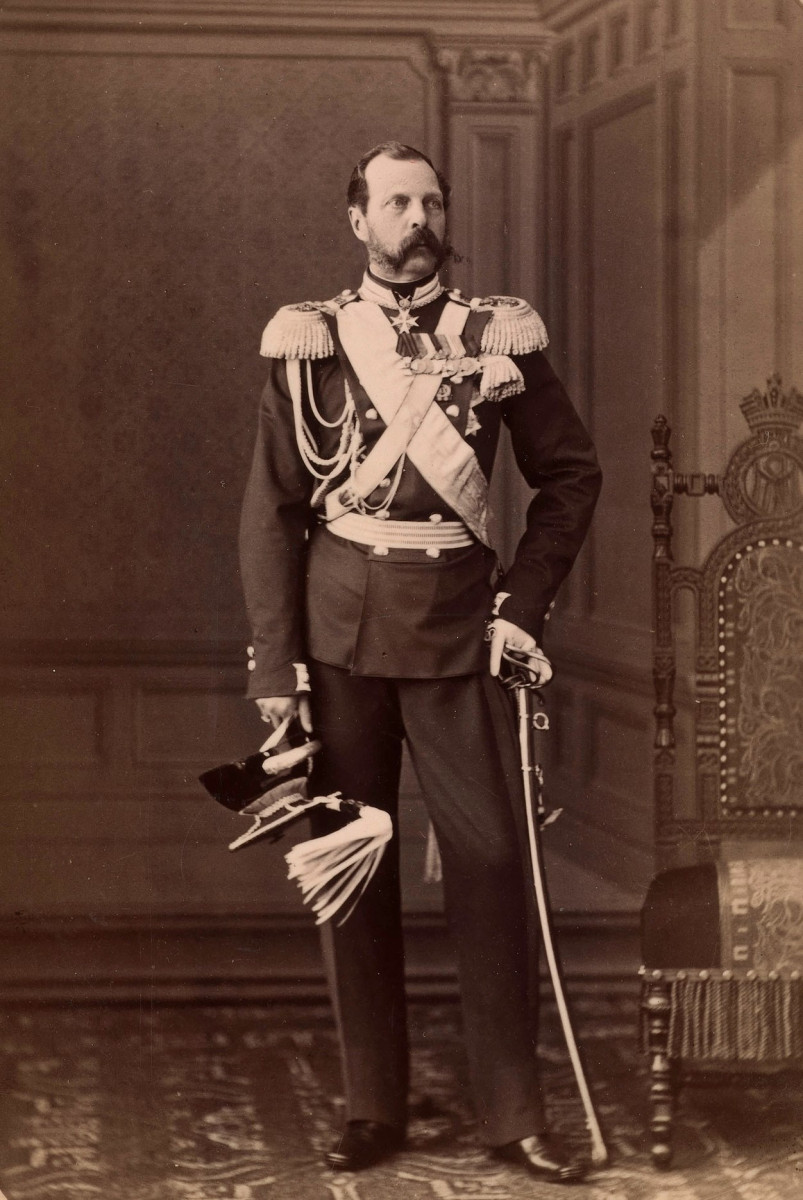
No one had expected the American consul to appear on board the Quaker City, but he appeared to inform them that Emperor Alexander II, who was holidaying in Livadia, would love to see American travellers as his guests.
Americans were worried. You bet! The invitation had been received from the monarch himself! Well, they had to adjust their itinerary and return to Yalta, because it’s not every day that you are lucky enough to meet with a powerful Tsar.
In his essay, Twain compared Yalta with the Sierra Nevada. He described the scenery colourfully: “The tall, grey mountains that back it, their sides bristling with pines – cloven with ravines – here and there a hoary rock towering into view – long, straight streaks sweeping down from the summit to the sea, marking the passage of some avalanche of former times – all these were as like what one sees in the Sierras as if the one were a portrait of the other. The little village of Yalta nestles at the foot of an amphitheatre which slopes backward and upward to the wall of hills, and looks as if it might have sunk quietly down to its present position from a higher elevation. This depression is covered with the great parks and gardens of noblemen, and through the mass of green foliage the bright colours of their palaces bud out here and there like flowers.»
While waiting for the imperial audience, the travellers decided to write a solemn greeting. A committee of six members of the group was chosen to do it. But in the end the text was written by Clemens alone.
The document has survived to this day. It is given almost in full below:
«Your Imperial Majesty!
“We, are a handful of citizens of the United States, travelling for recreation – and unostentatiously, as becomes our unofficial state, – have no excuse for presenting ourselves before Your Majesty, save а desire to offer our grateful acknowledgements to the lord of a Realm which, through good and through evil report, has been the steadfast friend of our Native Land.
“We could not presume thus to present ourselves did we not know that the words we speak and the sentiments we offer reflex the thoughts and the feelings of all our countrymen, from the green hills of New England to the shores of the far Pacific. Though few in number, we utter the voice of a Nation! <…>
“America owes much to Russia – is indebted to her in many ways – and chiefly for her unwavering friendship in seasons of our greatest need. That the same friendship may be hers in time to come, we confidently pray; that America is, and will be grateful to Russia and to her Sovereign for it, we know full well; that she will ever forfeit it by any premeditated, unjust act, or unfair course, it would be treason to believe.
“Yalta, August 26th, 1867.»
The US Consul read the address to Alexander II. Then he and his family came out of the Livadia Palace to welcome the American travellers.
At that time, relations between Russia and the United States were based on goodwill, because, having abolished serfdom in 1861, Russia greatly contributed to the eradication of slavery in the USA.
So, Alexander II came out to meet the Americans, and Mark Twain was most struck by the simplicity of his attire, as well as the calm and modest manners of the Russian monarch. After greeting the guests, the Emperor personally took them along the paths in the park, showing them the sights, which, of course, stunned the Americans.
Such was the journey to the Russian Empire of the future brilliant representative of American literature. And we believe that it was imprinted on his memory forever.