January 2026 marks the 240th anniversary of the birth of the architect Auguste Montferrand
By Teo Gurieli
The French architect Auguste Montferrand did not leave the most important trace in French architectural heritage, but in architectural work on Russian soil, mainly in St Petersburg.
Russian architects and architectural historians write about him with admiration, believing that Montferrand made an invaluable contribution to the architectural appearance of the then capital of the Russian Empire. One of Montferrand’s notable achievements is the brilliant completion of the central architectural complex of St Petersburg, which had begun to take shape under Peter the Great and developed in the eighteenth century thanks to the work of B. Rastrelli, A. Zakharov and C. Rossi.
But, according to historians, it was thanks to Montferrand that the entire esplanade from the Winter Palace (1754–1762) to the Senate and Synod buildings (1829–1834), which is almost a kilometre long, acquired the appearance that makes such a great impression today. Two key elements of this panorama are Montferrand’s creations: St Isaac’s Cathedral (1818–1858) and the Alexander Column (1834), forty-seven metres high and weighing 600 tons, erected in Palace Square by decree of Nicholas I in memory of Alexander I’s victory over Napoleon in the Patriotic War of 1812. The Column is crowned by a sculpture of an angel by Boris Orlovsky.
The obvious merit of Montferrand was that he was well aware of the combination of architectural elements and the real architectural environment, but we can only evaluate his legacy unbiasedly by tracing his creative path, especially on Russian soil.
Henri Louis Auguste Ricard de Montferrand was born on 23 January 1786 in Chaillot, a suburb of Paris. Benois Ricard, Auguste’s father, died prematurely, and the boy was brought up by his stepfather, the artist and engraver Antoine de Commarieux. It was his stepfather who taught the boy how to draw.
At the age of twenty Montferrand was admitted to the Paris Royal School of Architecture, but he was almost immediately called up for military service and enlisted in the 9th Horse Guards Regiment of Napoleon’s Guards. In 1806 he was wounded twice and, leaving the army the following year with the rank of sergeant, returned to Paris to continue his studies. Concurrently with his studies Montferrand served in the General Inspectorate of Architecture of Paris under Jacques Molinos. After graduating from school in 1813, he returned to military service. Having distinguished himself in the Battle of Hanau, he was awarded the Legion of Honour and received the rank of senior quartermaster.
Retiring shortly after the Battle of Leipzig, Montferrand resumed work under Molinos, participated in the building of the Church of St Mary Magdalene and in designing the environment for churches under restoration. From that time on his life was connected with architecture forever. He is considered to have been greatly influenced by his contemporaries: the undoubtedly talented architects Charles Percier and Pierre Fontaine.
Post–war French architecture was characterised, on the one hand, by a sharp decrease in the amount of building, especially of civil urban objects, and on the other – by an increase in interest in religious architecture, a trend that lasted till the last decades of the nineteenth century. Many architects, especially young ones, were engaged in restoring Gothic cathedrals and building new structures, relying on the principles of medieval architecture, which became the basis for neo-Gothic, or resorted to the so-called “high Baroque”. Young Montferrand was very impressed by both. But it was extremely hard to find a decent and large-scale job in France at that time. In April 1814, taking advantage of the Russian Emperor Alexander I’s stay in Paris, Montferrand presented the monarch with his Album of Various Architectural Designs Dedicated to His Majesty the Emperor.
Montferrand prepared the album carefully: in particular, he included drawings of designs that should seem important and even necessary to the Emperor. These were designs for an imperial country palace, a public library, a Triumphal Arch to the Brave Russian Army, a column in honour of Universal peace and an equestrian statue in honour of the Emperor. The drawings of the album were provided with a short list of building materials and even the approximate cost of their creation.
It should be noted that Alexander I was also presented with albums of designs by Fontaine and Percier, but though they were more venerable architects, their designs did not interest the Emperor, while Montferrand was invited to work in the Russian capital.
The fact that Montferrand was patronised by Agustin de Betancourt and Molina (1758–1824), an outstanding engineer and architect in the Russian service, must have played a significant role. A lieutenant general, a Spanish and Russian scientist, engineer, and statesman, he arrived in Russia in 1798 and a year later became head of the Russian Corps of Railway Engineers. For the rest of his life he headed the Institute of Engineers where he lectured on theoretical mechanics and machine theory, founding a scientific school of bridge building. In 1816 Betancourt became the head of the Committee of Buildings and Hydraulic Works in St Petersburg, and three years later became the chairman of the Main Directorate of Railways. From 1816 to 1818 he supervised the construction of the Expedition building (factory) of State paper provision and currency printing facility (now the Goznak currency printshop) in St Petersburg, for which he designed printing presses. Betancourt’s contribution to the establishment of the foundry and cannon factory in Kazan and the arms factory in Tula should be particularly noted. The famous Manege was built in Moscow to Betancourt’s design. C. Rossi, V. Stasov, and J. Bove participated in the implementation of his various projects. In 1818–1822 the first roadway in Russia was built under the direction of Betancourt: St Petersburg – Novgorod – Moscow.
Betancourt was clearly one of the most important confidants of Alexander I and his main adviser on a wide range of issues related to architecture and engineering.
Montferrand met him thanks to a letter of recommendation from the renowned watchmaker Abraham Louis Breguet. As it is in Pushkin’s immortal Eugene Onegin: “Onegin drives down the boulevard // And there he strolls, and takes his pleasure, // Till his breguet’s unsleeping chime // Tells him that it is dinnertime.” Distinguished by their high precision and beautiful design, Breguet’s watches were very popular in Russia among aristocrats and royalty at that time.
Betancourt liked Montferrand. Their collaboration began as early as 1817. At that time Betancourt was the chief builder of the Nizhny Novgorod Fair, and he decided to involve Montferrand in the design of some buildings. The principal one was the Old Fair Cathedral of the Saviour, the foundation stone of which was solemnly laid on 20 August 1818.
With all due respect to Montferrand’s best works, this cathedral can hardly be regarded as a new milestone in his work. The attempt to fuse Classicism and some forms of Byzantine architectural art was not very successful; as for ancient Russian architecture, Montferrand, apparently, was not yet familiar with it. At the same time, perhaps the building of the cathedral in Nizhny Novgorod helped him significantly in the process of designing his famous masterpiece – St Isaac’s Cathedral.
The new buildings of the Nizhny Novgorod Fair had been completed by 15 July 1822. Of these, only the Old Fair Cathedral of the Saviour, designed by Montferrand, has survived.
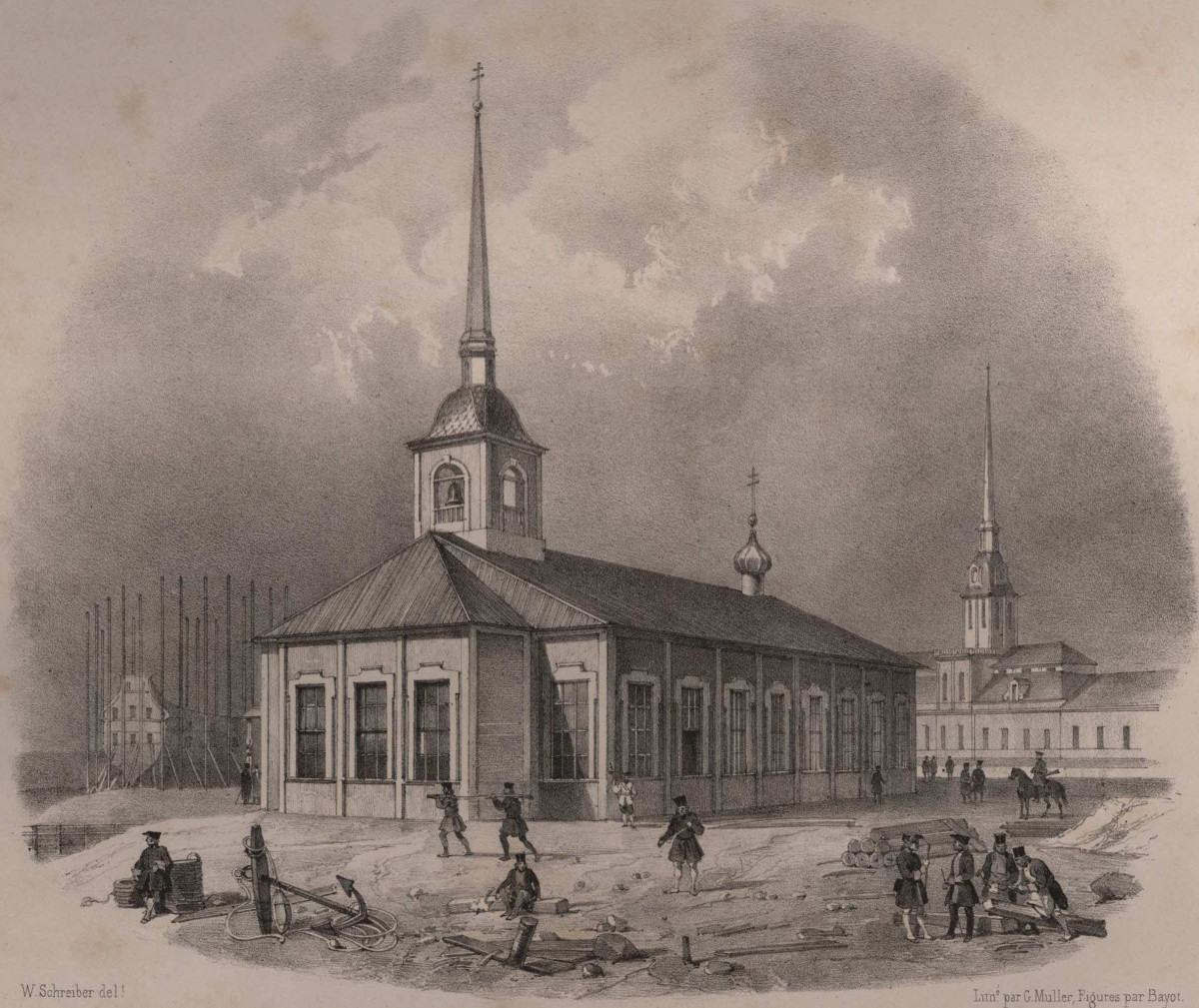
Meanwhile, the Russian aristocracy and the Orthodox Church were eagerly discussing a much larger and more important project for the Russian capital: to rebuild the Cathedral of St Isaac of Dalmatia, an early Christian hermit, monk and confessor (the fourth century) venerated by the Orthodox Church, known for his struggle against Arianism and the gift of prophecy. He founded a monastery near Constantinople and became its abbot. The first church, consecrated in honour of St Isaac of Dalmatia, was built at the behest of Peter the Great back in 1710.
The contest for the design of the new cathedral was announced in 1809. In 1816, after several unsuccessful attempts to hold it, Alexander I commissioned Agustin Betancourt, chairman of the newly formed Committee on Buildings and Hydraulic Works, to work out rebuilding plans for St Isaac’s Cathedral. Without much hesitation, Betancourt suggested entrusting the design to Auguste Montferrand.
In 1818 Montferrand presented a number of spectacular drawings of the future St Isaac’s Cathedral, and the Emperor liked them. A special commission was set up to rebuild the existing St Isaac’s Church. It included officials of the highest rank: the chairman was Count N. P. Golovin, a member of the State Council; Prince Alexander Golitsyn, Minister of Spiritual Affairs and Public Education, and, of course, Betancourt were among its members.
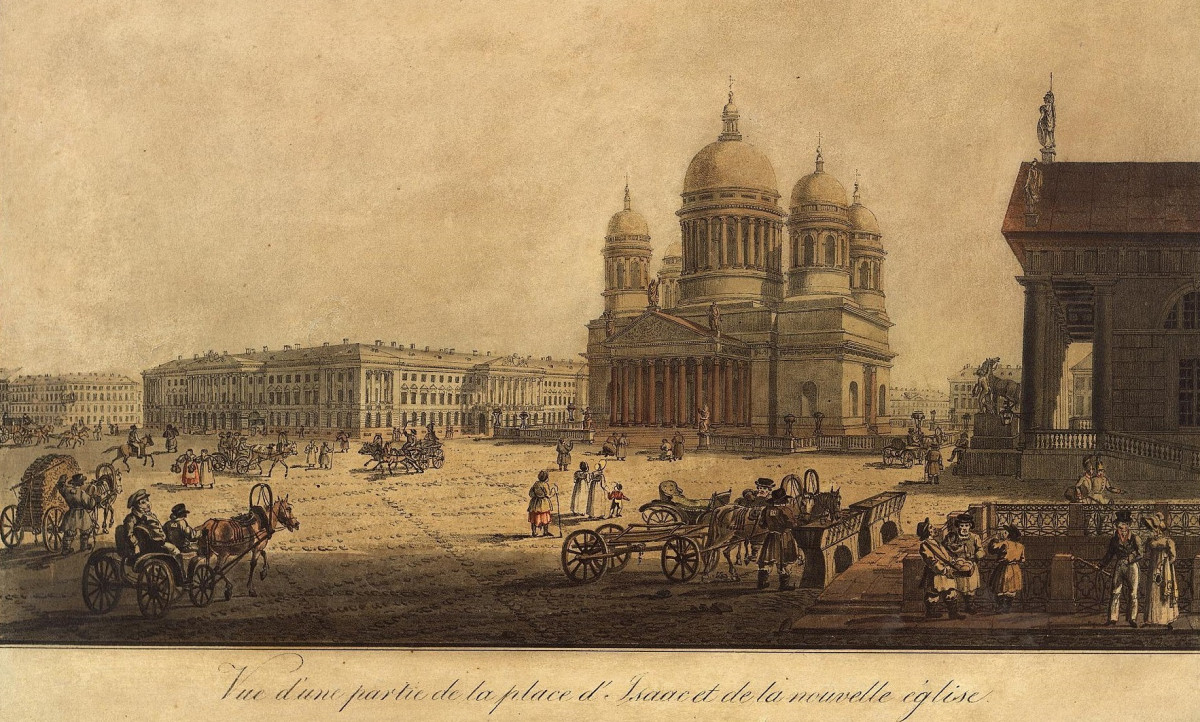
Building soon commenced. It was supervised by the architect himself who, apparently, was not very strict: embezzlements, forgeries and inflated estimates began. The scandal was hushed up, albeit with difficulty. The building had been going on for two years, but the detailed design had not been completed: in fact, there were only drawings of two facades, a general layout and one section.
And then, like a bolt from the blue, the President of the Academy of Arts A. N. Olenin received a letter from the architect Antoine Mauduit. He had been working in Russia since 1810, presenting several interesting designs, rebuilding the St Petersburg Bolshoi Theatre and building several houses. He had one advantage over Montferrand: he was also a good engineer. In a letter to Olenin he announced that Montferrand’s calculations regarding the stability of the building were incorrect, and the technical qualities of the loadbearing structures did not hold water; in other words, the author of the design had shown total incompetence. Moreover, Mauduit supported his conclusions with drawings and calculations.
Initially the Academy took the message with a fair amount of scepticism: The Russian Empire’s main cathedral was too tasty a morsel for European architects to keep from brawling. The Academy decided to present the story as a conflict between two architects, and the Commission for the Building of St Isaac’s Cathedral did not give it wide publicity. Then Mauduit turned directly to the Emperor.
In February 1822 the Tsar suspended Montferrand from work, halted the building work, and ordered a special committee to be set up at the Academy of Arts, headed by A. N. Olenin, to consider Mauduit’s comments on the building of St Isaac’s Cathedral. It was only then that it emerged that there was no cross-section in the building plans for the cathedral. It revealed all of Montferrand’s errors. Experts recognised that it was impossible to build the cathedral to the existing design.
It was an incredibly complicated situation. Lots of money had already been invested in the building. Rumours were spreading in the country about the “wrong choice of the architect”, “the authorities’ incompetence”, and “unreasonable expenses”. The monarch decided to stop the rumours about the wasted funds and, since the building had gone too far, resolved to continue it. V. P. Stasov, A. A. Mikhailov 2nd, A. I. Melnikov, P. P. Bazin and V. I. Beretti took part in correcting the design. Mauduit failed to replace Montferrand.
On 9 March 1825 Montferrand’s revised design was presented to the Emperor. It was recognised again as the best and approved by Alexander I.
On 13 April 1825 Montferrand continued building the cathedral under the tutelage of such major experts of architecture as V. P. Stasov, A. I. Melnikov, and A. A. Mikhailov 2nd. However, it should be admitted that without Mauduit’s intervention Montferrand would hardly have completed his project.
Anyway, Montferrand won. He eventually built the largest and most important cathedral in St Petersburg.
But there remains one more question that still interests architectural historians, especially in the UK. Studying hundreds of cathedral designs worldwide, they concluded that Montferrand’s original design of St Isaac’s Cathedral would not have been born but for an earlier design: that of St Paul’s Cathedral in London. The difference between them is primarily in the age and style: the London cathedral was completed in 1708 and built by the architect Christopher Wren in the Baroque style, whereas Montferrand made his design over 100 years later and built it in the style of late Classicism. But architects note the fact that Montferrand successfully used all the elements that are combined in Ren’s creation: porticoes commensurate with the structure, belfries, a dome surrounded by a gallery, pediments and sculptural decor. In the nineteenth century thousands of engravings depicting St Paul’s Cathedral circulated throughout Europe, and Montferrand probably could not resist the temptation to embody Wren’s most interesting ideas in his design of St Isaac’s Cathedral.
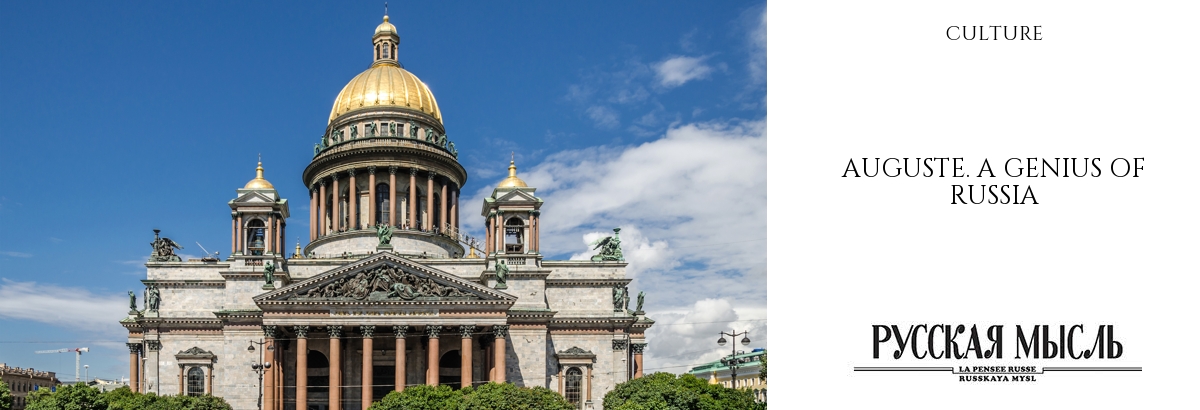
St Isaac’s Cathedral is reputed to be an exceptionally important urban dominant. It is 101.5 metres tall, and its dimensions in the plan (with porticoes) are 111.5×97.6 metres. The monumental building is decorated with four eight-column porticoes and crowned with a metal gilded dome on a drum surrounded by monolithic granite columns. It took forty years to build the edifice. The solemn consecration of the new cathedral on 30 May (11 June) 1858 was performed by Metropolitan Gregory of Novgorod, St Petersburg, Estonia and Finland.
Montferrand’s last work was the design of the St Petersburg monument to Emperor Nicholas I, which, however, the man of genius did not have time to complete; this work was completed by the architect D. Ye. Efimov.
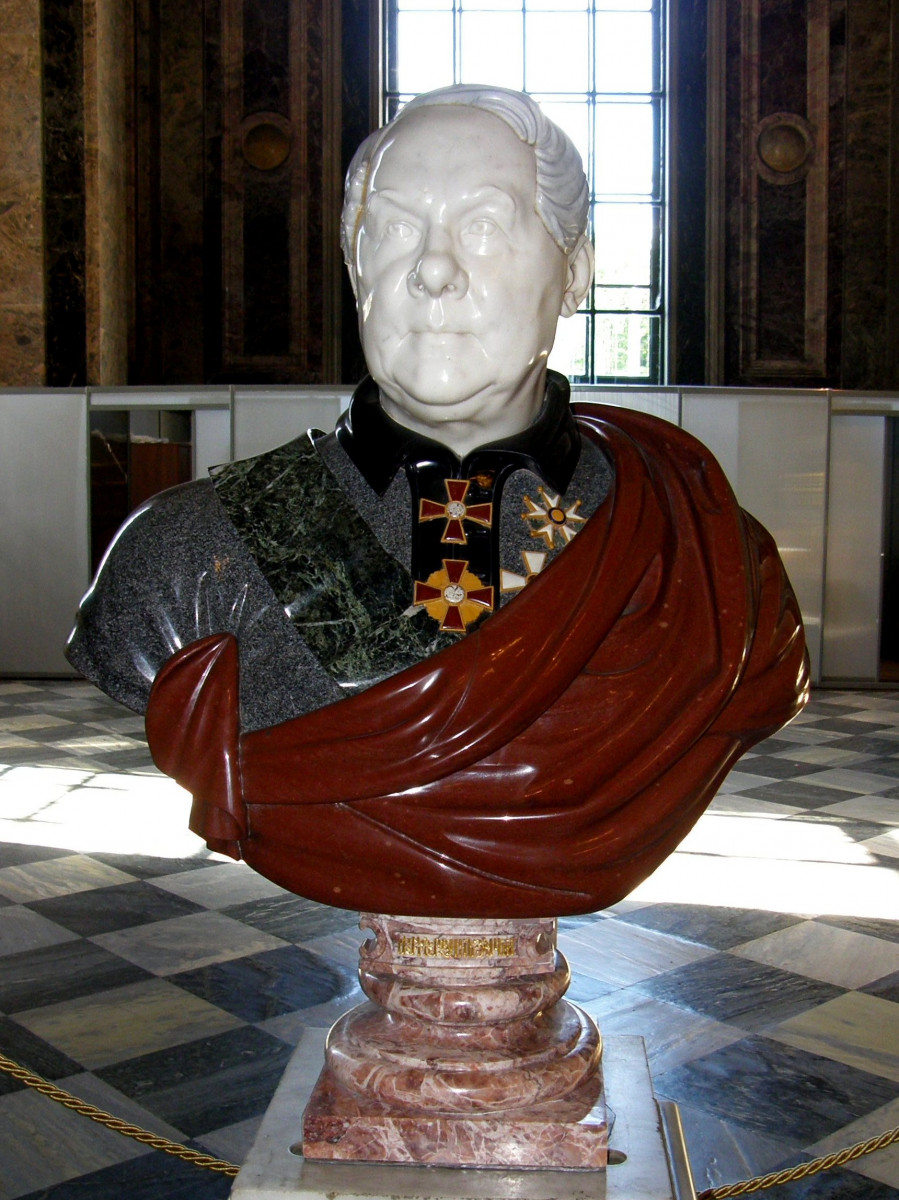
Montferrand was gifted in various fields of fine art. The artistic part of the original design of the Alexander Column was excellently executed with watercolour technique and testifies to Montferrand’s high skill as an artist. This sketch is currently in the library of the St Petersburg State Transport University. He was a good draughtsman and often painted portraits of his contemporaries in Russia.
Montferrand’s efforts were generously rewarded. For building St Isaac’s Cathedral, he received the rank of active state councillor, 40,000 silver roubles and a gold medal decorated with diamonds on St Andrew’s Ribbon; and for building the Alexander Column – the Order of St Vladimir, 3rd Degree, and 100,000 silver roubles. In Russia he received three orders: the Order of St Vladimir, 4th Degree (1826); the Order of St Anna, 2nd Degree with diamonds (1828); and the Order of St Vladimir, 3rd Degree (1834).
Montferrand passed away in 1858 in St Petersburg. A curious detail: the protracted building caused rumours about a prophecy allegedly received by the Frenchman from a passing clairvoyant who predicted that the architect would die once the cathedral was completed. And indeed: a month after the solemn ceremony of the consecration of St Isaac’s Cathedral Montferrand passed away.
The architect wished to be interred in one of the underground vaults of St Isaac’s Cathedral, the building of which he completed just a month before his demise. However, Emperor Alexander II did not give permission for this, since Montferrand was a Catholic. As a result, the funeral ceremony took place at the Catholic Church of St Catherine of Alexandria in Nevsky Avenue, and then the funeral procession circled St Isaac’s Cathedral thrice. Subsequently, his remains were taken to France. Montferrand rests in the Montmartre Cemetery next to his mother Louise Fistioni and stepfather Antoine de Commarieux.